Inside Qu's IoT Smart Kitchen and Presto's Voice AI Phone Product: What RLC Tells Us About the Back-of-House Race
The cluster of launches at RLC 2025 — Qu's IoT smart kitchen, Presto's voice AI phone product, Lunchbox's free order-aggregation middleware, and Portillo's Restaurant of the Future — shows the back-of-house data layer is being built faster than enterprises can integrate.
I am writing this from a small table tucked between two coffee urns on the third floor of the JW Marriott Phoenix Desert Ridge, and the lanyard around my neck has the kind of weight that only exists at conferences where the badge has been bumped against a hundred other badges in three days. The Restaurant Leadership Conference closes tomorrow. The official count this year is north of 1,700 operator attendees, and the organizers like to remind you, twice per general session, that 84% of those attendees are VP-level or above. That number is doing a lot of work in the room. It is the reason every booth has a polished demo and a sales engineer in good shoes. And it is the reason, when I corner a CIO from a 1,200-unit pizza brand near the espresso bar and ask him what he is actually going to buy this year, he looks at me for a beat too long before saying, “Honestly? Nothing that was announced this week.”
That is the gap I want to write into this morning. Because the launches at RLC 2025 have been, on the merits, real. Qu rolled out an IoT smart kitchen that monitors equipment performance and energy usage in real-time, and the demo unit on the floor is not vaporware — there is a working grill telemetry rig, a working refrigeration alert flow, and a working dashboard with thresholds that you can adjust by sliding your finger. Presto announced a voice AI phone-order product and shipped a marketing page at presto.com/voice-ai/ before the show opened. Lunchbox put out a free order-aggregation middleware tool aimed squarely at the segment of independents and small chains who have been quietly bleeding margin to Otter and Chowly subscription fees. And Portillo’s, in the kind of press release that the consultant-class lives for, announced its “Restaurant of the Future” prototype for Grapevine, Texas, with a smaller footprint, a double drive-thru, and a kiosk-forward order layout. (Restaurant Technology News has the recap up at restauranttechnologynews.com/2025/04/restaurant-technology-news-recap-week-of-april-20-2025/ — they file these weekly and they are usually the cleanest aggregation of the show-floor news.)
So why is the CIO at the espresso bar telling me he is not buying any of it?
Because the integration gap is bigger than the product gap. And the vendor who wins the next eighteen months at the enterprise tier is not the one with the prettiest new feature. It is the one who ships a credible integration story to a POS stack that the operator has already paid for, already trained on, and already wired into their payroll and inventory systems. Everything else is a demo.
That is the thesis. The rest of this piece is the receipts.
The Qu demo, and what’s actually under the hood
The Qu booth is in the back-left quadrant of the main hall, which at RLC is the quadrant the kitchen-tech vendors get because the front-of-house and loyalty vendors take the real estate near the keynote doors. I spent forty minutes there yesterday afternoon, because the demo is genuinely interesting and because the sales engineer running it — a woman named Marisol who used to run IT for a mid-sized casual dining brand — has the kind of vocabulary that tells you she has actually deployed something against a real P&L.
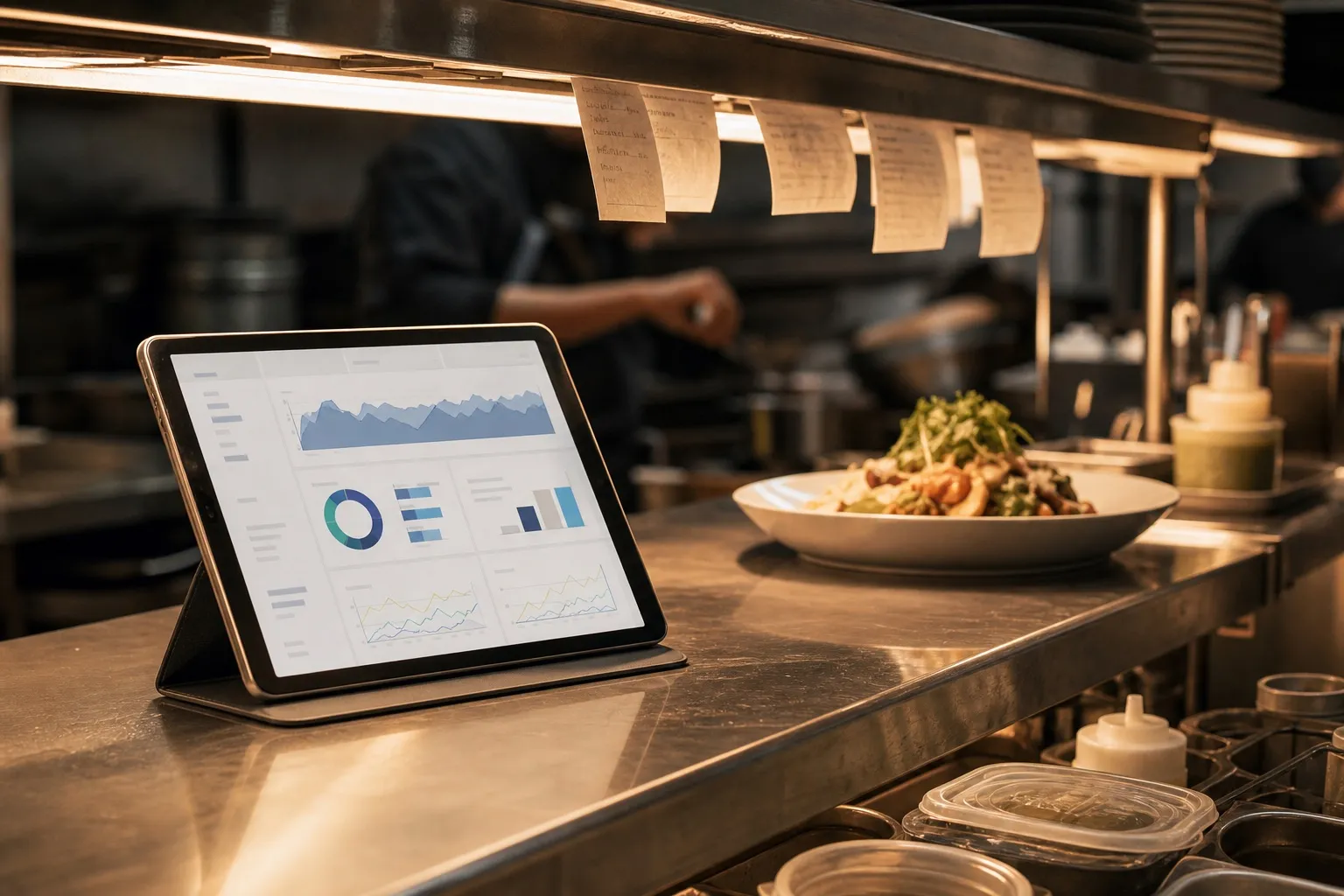
The pitch is this. Qu’s IoT smart kitchen layers a thin telemetry mesh over existing kitchen equipment — grills, fryers, walk-ins, prep tables, hood systems — and pipes the data into the same back-office stack that already runs the brand’s menu management and order routing. The headline use cases are equipment performance (is this fryer running at temperature, is the grill platen calibrated, is the walk-in cycling within spec) and energy usage (which station is your biggest draw at lunch, where can you stage shutdowns during the dead hour between two and four). The alert flow is opinionated — Qu picks the thresholds, you tune them, and the system escalates to a named operator role rather than blasting the manager’s phone.
What is actually new here is the integration posture, not the sensors. The sensor stack itself is commodity. You can buy temperature probes, current clamps, and door-cycle counters from a half-dozen industrial IoT vendors, and most of the equipment-as-a-service plays from the manufacturers already have their own telemetry SDKs. What Qu is selling is that the data lands inside the same dashboard the operator already uses for menu mix and store-level performance — which means the regional ops director doesn’t have to log into a new tool. That is the whole game.
The thing the Qu pitch does not address, and the thing I pressed Marisol on twice, is what happens when the brand’s POS is not Qu. Most enterprise brands are not Qu-POS shops. They are Toast, NCR, Oracle, PAR, or some custom stack glued together by a systems integrator in 2018 that nobody on the current IT team fully understands. Qu’s answer is the right answer — they have an integration layer, they publish webhooks — but “we have webhooks” is not an integration story. It is the precondition for one. The integration story is “we have shipped a working connection to your specific POS, in production, at three brands your CIO has heard of, with documented latency and a named support contact.” And on that, Qu is closer than most, but they are not there yet.
Why Presto’s phone-order play is the bet I’d take
Presto’s voice AI phone-order product, on first read, is the kind of launch that gets eye-rolls from the cynics in the press room. We have all seen drive-thru voice AI demos that work in the booth and fall apart in the parking lot. And Presto specifically has had a bumpy public-market story over the last two years that has made every product they ship a target for short sellers.
I still think this is the bet I’d take, and here’s why.
Phone orders are the wrong problem to solve with humans. They are interrupt-driven, they are unpredictable in volume, they pull a line cook or a cashier out of a flow state, and they have an error rate that is bounded only by how patient the customer is willing to be. The unit economics of using a $17/hour line cook to take a phone order during a Friday rush are catastrophic. The reason phone orders are still handled by humans in most full-service and pizza brands is not because operators love it. It is because the alternative — a phone tree, a third-party answering service, or a voice AI that gets the order wrong — has historically been worse.
Presto’s product, based on the demo I sat through Monday morning and the conversation I had with their head of product yesterday at the bar, finally clears that bar. The voice model handles modifiers. It handles upsells. It handles the specific failure mode that has killed every prior voice AI in this category, which is the customer who says “actually, can you make that without onions” three sentences after they have already confirmed the order. And — this is the part that matters — it integrates with the POS as a first-class order channel, not as a CSV import. The orders land in the kitchen the same way a kiosk order would, with the same modifier structure and the same routing logic.
The reason this is the bet I’d take is not that the technology is uniquely great. It is that the integration story is good enough, and the labor math is so brutal that even a 60% capture rate — where the AI handles the easy 60% of calls and routes the complex ones to a human — pays back the deployment in under a year for any brand doing more than thirty phone orders a day per store. As our later Vibe Check on the POS-side AI argues, the question is not whether the major POS platforms will embed voice as a native channel — they will. The question is whether they build it or buy it. Presto, today, is the most credible buy target in that conversation.
Lunchbox’s free-middleware move, decoded
The Lunchbox announcement has been least covered on the show floor and is, in my read, the most strategically interesting of the four. Lunchbox is releasing a free order-aggregation middleware that pulls third-party delivery orders — DoorDash, Uber Eats, Grubhub, regional players — into a single tablet view and injects them into the POS. Free. No subscription tier. No per-order fee.
Nobody ships software for free. The play here is obvious if you have been watching the middleware market. Otter, Chowly, Cuboh, and smaller players have built real businesses charging $80 to $250 per store per month for the same functionality. The assumption inside the category has been that aggregation middleware is a durable subscription line. Lunchbox is calling that bluff.
What Lunchbox is actually selling is the lead funnel into the rest of their stack — online ordering, loyalty, marketing automation, the catering module they relaunched last year. The free middleware gives them a tablet on the counter in every store that signs up, which gives them a daily-active surface, which gives them an upsell path. It is the same playbook that Toast ran with free hardware in 2018, and that Square ran with free card readers in 2013.
The operator question is not “should I take the free Lunchbox tool.” The operator question is “what does my data architecture look like after I take it.” The moment you wire a third-party tablet into your POS as the canonical source of delivery orders, you have made a strategic vendor commitment, even if the line item on the P&L says zero. Switching costs in aggregation middleware are real — order history, menu sync mappings, refund flows. The free tier is the wedge. The lock-in is the catering module and the loyalty program that comes eighteen months later.
I do not think this is bad. The vendors who have been charging $150 per store per month for what is essentially a webhook router are about to have a very hard year. But the operator who signs up should sign up with eyes open about what they are actually buying, which is a relationship, not a tool.
Portillo’s Restaurant of the Future and the Burgerbots comp
The Portillo’s announcement landed Monday afternoon. The Grapevine, Texas prototype is the kind of thing that the trade press loves — smaller footprint than the standard Portillo’s box, a double drive-thru lane, an interior that is kiosk-forward with a reduced cashier count, and a kitchen layout that the company is describing as “optimized for digital order volume.” The CFO walked through the unit economics on a slide I am not allowed to photograph, but the headline number was a meaningful reduction in build-out cost per unit and a meaningful improvement in throughput per square foot.
Two things to say about this.
First, “Restaurant of the Future” prototypes are a genre. Every enterprise brand has done one in the last five years. McDonald’s did one. Chipotle did one (and is doing another). Wendy’s has done several. Taco Bell did the Defy. The genre tells you what the brand wants to be seen as betting on more than what the brand is actually going to roll out at scale. The Portillo’s announcement reads, to me, as a signal to the public markets and to franchisees that the brand has a forward-looking digital story.
Second — and this is the comp I want to draw — the Portillo’s prototype lands in the same conversation as the Los Gatos restaurant opening next week, the one with the burger-flipping robotic arm that everybody on RestaurantTok has been arguing about. (Burgerbots opens April 21; the announced opening is still six days out from where I am sitting today.) The Burgerbots play is the maximalist version of automation: replace the cook line with a robot. The Portillo’s play is the moderate version: replace some of the front-of-house labor with kiosks, redesign the kitchen for digital order flow, but keep the cooks. Both are bets on the same underlying trend, which is that the cost structure of a 2015-era enterprise restaurant is no longer competitive against the cost structure of a 2025-era operator who has designed for digital from the studs.
The thing that ties Portillo’s, Qu, Presto, and Lunchbox together is that they are all assuming the operator has a clean data layer underneath them. Equipment telemetry from Qu is only valuable if the operator can correlate it with order mix. Voice AI from Presto only works if the orders flow into the same kitchen display as everything else. Aggregation middleware from Lunchbox is only useful if the POS can ingest the orders cleanly. The Restaurant of the Future only delivers the throughput gain if the kiosk, the kitchen display, the labor scheduling, and the inventory system are talking to each other.
And that data layer, at most enterprise brands, is a mess.
The integration gap most vendors are dodging
I have been writing about restaurant tech for long enough to know that “integration” is the word vendors use when they want to make the operator do the work. When a vendor says, on a sales call, “we integrate with Toast” — what they mean, ninety percent of the time, is that they have a documented webhook spec and a sample integration that one customer built in 2022. They do not mean that the integration is supported, maintained, monitored, and contractually guaranteed to work through the next Toast platform release.
This is the gap hiding underneath every announcement at RLC this year.
Qu’s smart kitchen needs to integrate with the operator’s POS, their labor system, their inventory system, and — if the operator wants to do anything sophisticated with the energy data — their facilities management stack. Presto’s voice AI needs to integrate with the POS, the menu management system, and the loyalty platform. Lunchbox’s free middleware needs to integrate with whatever delivery aggregator stack the operator already has, plus the POS, plus the kitchen display, plus the refund flow. Portillo’s Restaurant of the Future needs all of the above plus the kiosk vendor, the drive-thru order confirmation board, and the back-office reporting that the CFO sees every Monday morning.
Each of these integrations, individually, is solvable. The hard problem is the combinatorial. An enterprise brand running 800 stores with a mixed POS stack across three regions, two delivery aggregator contracts, and a labor system migrated from one vendor to another in 2022 is not looking at four product purchases. They are looking at forty integration projects, each with its own scope, its own contract, its own UAT window, and its own risk of regressing something else in the stack.
This is why the CIO at the espresso bar told me he is not buying any of it. Not because the products are bad. The products are, by and large, fine. He is not buying because his integration roadmap for 2025 is already full, and every new product purchase pushes something else off the roadmap, and the thing that gets pushed off is usually the thing that was supposed to deliver the savings that pays for the new product purchase. It is a budgeting problem disguised as a procurement problem.
The exception is the enterprise-AI playbook that the largest hospitality operators have been quietly running. In a piece we later publish on enterprise-scale AI deployment, I dig into how Marriott is approaching the same integration problem from the brand-portfolio side, and the short version is that the winning move is not to buy the product. It is to buy the integration capability — either by hiring it in-house, by signing a long-term contract with a systems integrator who owns the maintenance burden, or by selecting vendors who will commit to the integration as a deliverable rather than as a checkbox. Enterprise restaurant operators are eighteen months behind enterprise hospitality on this.
What I think is actually going to happen
Here is my prediction, for whatever a prediction from a writer at a folding table next to two coffee urns is worth.
The Qu IoT smart kitchen is going to get adopted at the brands where Qu is already the POS, and it is going to struggle to break out of that footprint until they ship two or three reference integrations with Toast or NCR. That will probably happen in the back half of 2025, and once it does, the product will become a serious line item in 2026 RFPs.
The Presto voice AI product is going to get adopted faster than people think, specifically in pizza and regional full-service where phone-order volume is high and labor cost is the binding constraint. The technology is good enough now. The labor math is so painful that the deployment risk is worth it. I would not be surprised to see one of the major pizza brands announce a multi-store pilot in the next two quarters, and I would not be surprised if it is Presto rather than a build.
The Lunchbox free middleware play is going to compress the aggregation-middleware market hard. Otter and Chowly will respond — probably with their own free tiers — and the standalone aggregation-middleware subscription business is going to be substantially smaller a year from now than it is today. Operators win. Vendors who were charging rent on a webhook router lose.
The Portillo’s Restaurant of the Future will open, will get a flattering write-up in every trade publication, and will deliver a real but smaller-than-promised throughput gain. The model will start showing up in the brand’s new-unit pipeline by 2027. It will not be a revolution. It will be a steady, incremental redesign that the brand will tune over a decade.
The integration gap, meanwhile, will continue to be the single biggest determinant of which vendors win and which get acquired for parts. The Toast IPO is the cleanest comp. Toast did not win because they had the best POS features. They won because they shipped an integration story — hardware, payments, payroll, loyalty, online ordering — that competitors took five years to even attempt to match. The next Toast in this category will do the same thing for the back-of-house data layer, and based on what I saw on the show floor this week, that vendor has not yet shown up in a way that any of the CIOs in the espresso line are willing to bet on.
Operator takeaways
If you are an enterprise operator reading this on Wednesday morning after the show closes, here is what I would put on a sticky note next to your monitor for the rest of the quarter.
-
Do not write “integrations with leading POS” into your RFP. Write “named, supported, production integrations with our specific POS version, with documented SLAs and a contractually committed maintenance path through the next two platform releases.” If the vendor cannot answer that question on the second sales call, they are not ready to deploy at your scale.
-
Treat the Lunchbox free middleware as a strategic decision, not a tactical one. The tablet on the counter is a vendor relationship, not a tool. Run the same vendor-evaluation process you would run for a paid product. The price tag is not the cost.
-
Pilot voice AI on phone orders before you pilot it on drive-thru. The phone-order use case has a higher tolerance for latency, a lower error-cost when things go wrong, and a cleaner integration surface. If your voice AI vendor is leading with drive-thru, push back and ask them to deploy phone-order first. The vendors who are confident in their product will say yes.
-
Ask your Qu, Presto, or kitchen-IoT rep for the integration runbook before you ask for the price sheet. If they have one, the deployment is real. If they do not, you are buying a demo.
-
Budget your integration capacity for 2025, not your product purchases. Most enterprise brands are integration-constrained, not capital-constrained. The bottleneck is your team’s ability to land new vendors cleanly, not your CFO’s willingness to sign the contract. Plan accordingly.
What to write into your Q3 RFPs
Three specific clauses, lifted from RFPs I have seen the best-run enterprise operators issue over the last two years.
First, an integration commitment clause: the vendor warrants that the named integrations will remain in production through the contract term, with a defined maintenance response time, and with a defined remediation path if the underlying platform (POS, KDS, labor system) issues a breaking change. The vendor — not the operator — owns the work of keeping the integration alive.
Second, a data portability clause: the operator owns its own data, can export it in a documented format at any point during the contract, and can take that export to a competing vendor without paying a data-extraction fee. This sounds obvious. It is not in most contracts.
Third, a roadmap commitment clause: the vendor commits to a published product roadmap for the contract term, with material deviations triggering a contract reopener. This is the clause that prevents the “we were going to ship that feature, but we got acquired and the new owner deprioritized it” outcome that has burned every operator in this category at least once.
If you put those three clauses into your Q3 RFPs, you will get fewer responses, and the responses you get will be from the vendors who are actually capable of operating at enterprise scale. That is the filter. That is the whole filter.
The show closes tomorrow. The Yelp Spring Release is two weeks out, Wendy’s reports Q1 on the 30th, Hilton on the 29th, and the DoorDash/SevenRooms deal will land in early May with its own set of integration questions to ask. There is a lot coming. The vendors who win the next eighteen months will be the ones who answer the integration question before they answer the feature question. The operators who win will be the ones who write the question into the contract before they write the check.
I will be at the closing keynote in the morning, and at the airport bar after. If you are an operator with a story about a vendor who actually shipped the integration they promised — or, more usefully, one who did not — I want to hear it.
— Priya files The Operator. Tips: tips@tabletransfers.com.
Featured
More
Browse all 494 posts
The Voice Agent Maturity Curve
mise
·12 min read
The Four Margins of a Restaurant
mise
·14 min read
The AI Premium in Hospitality M&A: Broker Story or Real Number?
the bottom line
·9 min read
What the DoorDash/SevenRooms Deal Actually Buys
the bottom line
·11 min read