Wendy's FreshAI: Inside the Most Aggressive Drive-Thru AI Rollout in QSR

Wendy's enters 2025 with the most explicit chain-level AI commitment of the cycle: FreshAI, powered by Google Cloud LLMs, in over 100 live locations with 86% pilot accuracy on its corporate blog. The operator case study.
It is forty-one degrees and barely past sunrise in a strip-mall parking lot outside Columbus, Ohio, and I am eavesdropping on a robot taking a breakfast order. The car ahead of me — a silver Equinox with a Buckeyes decal — has just rolled up to the speaker post at a Wendy’s that has been quietly running FreshAI since last year. The voice that greets the driver is not a teenager pulling a 5 a.m. shift. It is even, pleasant, fractionally synthetic in the way that only becomes obvious if you are listening for it. It asks what the driver would like. The driver says “uh, can I get a Baconator combo, medium, with a Coke, and uh, also a side of seasoned potatoes — no, sorry, make those the regular hash browns.” There is a half-beat pause. The voice confirms: Baconator combo, medium, Coca-Cola, regular seasoned potatoes — and then catches itself and re-reads the order back without the seasoned potatoes, with the hash browns substituted, and asks if that is correct. The driver says yes. A human voice — a manager, I think — chimes in for the upsell and the goodbye. The car rolls forward. The whole transaction took maybe seventy seconds.
I sit in my own car for another ten minutes pretending to look at my phone, watching cars cycle through. By the time my Frosty Cream Cold Brew is in my hand I have observed thirteen orders and exactly one obvious failure mode: a customer who tried to special-order off-menu (“can I get a Dave’s Single but with the Baconator’s bacon on it”) and was politely punted to the human. The handoff was fast. The customer did not seem annoyed. The line kept moving.
This is the most interesting drive-thru I have stood in since I started covering this beat, and I have been thinking about why for the last six weeks. It is not because the technology is uniquely novel. It is not because the accuracy is uniquely high. It is because Wendy’s — alone among the major American QSR chains entering 2025 — has put a real, specific, public number on the deployment side of voice AI and then walked the math forward into its strategic plan. That is a different kind of disclosure than we have been getting from McDonald’s, from White Castle, from Carl’s Jr., from any of the chains that have piloted, paused, expanded, paused again, and quietly let press cycles move on. Wendy’s is doing the opposite. It is leaning in, in writing, with specifics. As I will argue in this piece, that disclosure posture is the actual case study. The accuracy number is almost a sideshow.
This is the Operator case study on FreshAI as it stands the first week of 2025.
What FreshAI actually does at the speaker post
Let me start with the boring, useful part: what is the thing.
FreshAI is the Wendy’s-branded name for a voice ordering agent that sits at the drive-thru speaker post, takes the customer’s order in natural language, parses it against the menu and the customer’s modifications, prices it, sends it to the kitchen system and the order confirmation board, and — when something is out of scope — escalates to a human team member who can either complete the transaction or correct the AI’s parse before sending it through. The system is built on Google Cloud’s large language model stack, which Wendy’s has confirmed in its corporate blog disclosure on FreshAI, and which has been corroborated in trade reporting at Restaurant Business and Restaurant Dive.
What is interesting about that stack choice is that it is not the same stack that powers most of the conversational consumer products people have been seeing in their daily life. Wendy’s is not running a wrapper around a generic chat model. It is running a domain-tuned pipeline whose top job is order disambiguation — turning “no wait actually make that two of the spicy chickens and one regular, with one of them no pickles, the other one extra mayo, and a Frosty for the kid” into a structured POS payload that the kitchen will not mis-execute. That is a parsing problem more than a conversation problem. The conversation layer is the easier half. The hard half is the modifications graph: which items have which modifications available, what the price deltas are, what the substitution rules look like, what the inventory state is right now, and whether the customer’s last utterance amended, replaced, or appended to the earlier ones.
I watched the system handle three things well at the Columbus location. First, mid-order substitution — the hash browns case I described above. Second, accent and prosody — a driver with what sounded like a thick West African accent ordered a four-piece spicy nugget meal without any apparent friction, which is a regression case the speech recognition layer would have flunked five years ago. Third, ambient noise — a screaming toddler in the back of one car, audible from my position two cars back, did not visibly derail the parse.
I watched it handle one thing badly: the off-menu construction I mentioned. That is the right thing for it to flunk. You do not want an AI agent inventing a Frankenburger SKU that the kitchen does not know how to ring or build. The escalation behavior is the correct behavior. But it is worth noting that “escalates politely to a human” is not the same as “completes the order.” That distinction matters for the accuracy number, which I will get to.
The cumulative throughput of FreshAI is, on Wendy’s own disclosure, “tens of thousands of orders per day” across the live fleet — a figure that as of Wendy’s published material covers more than 100 live restaurants. That is the disclosure baseline as Wendy’s enters January 2025: 100-plus live locations, tens of thousands of daily orders being processed through the voice agent, 86% pilot accuracy. Those are the three numbers I want operators to commit to memory.
The Google Cloud LLM stack, decoded
The vendor stack matters because it tells you what the cost curve looks like and what the failure modes look like. Wendy’s has said publicly — in both the corporate blog post and the trade coverage — that FreshAI sits on Google Cloud’s LLM platform. In practical terms, that means three things for an operator trying to evaluate this case study.
First, the inference economics are bounded by Google’s published pricing for whatever foundation model tier Wendy’s has been allocated. Wendy’s has not disclosed which specific model or tier, and I am not going to guess. What I will say is that drive-thru voice traffic is, in machine learning terms, a relatively friendly workload: short conversations, bounded vocabulary, latency-sensitive but not latency-extreme. It is the kind of workload where the per-call cost should be small in absolute dollars and small as a fraction of the average ticket. If anyone tries to sell you a per-location cost figure for this rollout, ask them where they got it. I have not seen Wendy’s publish one, and I do not have one. I would be skeptical of any number circulating in the channel that is not sourced to a Wendy’s filing or investor day deck.
Second, the speech recognition layer is presumably also Google’s — Google has shipped strong ASR (automatic speech recognition) for years, and the integration story is much cleaner if Wendy’s is using one vendor end-to-end. This matters because ASR is where the noise-floor failures happen. A bad ASR layer compounds into a bad LLM parse no matter how clever the LLM is. The fact that I watched the Columbus location handle a thick accent and a screaming kid in the back seat without choking is, indirectly, an ASR endorsement.
Third, the lock-in is real but not catastrophic. Wendy’s is building on Google Cloud, but the layer that knows the Wendy’s menu, the modifications graph, the upsell rules, and the escalation logic is presumably Wendy’s own. If the foundation model under FreshAI changes generations — and over a five-year horizon, it absolutely will — the orchestration logic, the eval suites, and the menu schema all travel. That is the kind of vendor relationship where you have leverage on renegotiation because you are not handing the vendor your entire product surface.
I will note, because someone will email me if I do not, that Wendy’s vendor disclosures on FreshAI predate the current intensified competition between Google, OpenAI, and Anthropic for enterprise inference workloads. If you are a Wendy’s competitor reading this and you have a CIO who is wavering on which platform to standardize on for voice agents in 2025, that competitive landscape is now your friend. The pricing leverage in this space is the best it has been in two years.
Why 86% is a number that hides the variance
The headline number from Wendy’s corporate blog is that FreshAI is hitting 86% order accuracy in its pilot footprint. I want to spend a minute on what that number means and what it does not mean, because I have already seen it mis-cited in the channel three different ways.
What it does mean: in a measured sample of orders processed by FreshAI, the AI completed 86% of orders correctly end-to-end — order taken, parsed, priced, and sent to the kitchen with no human correction needed. That is a strong number for an AI system operating at the speaker post in 2024 with the diversity of accents, ambient noise, and customer ordering styles that a national QSR chain sees. It is materially better than the figures other chains have publicly reported during their pilot phases, and it is materially better than what most of us were quoting eighteen months ago when McDonald’s pulled the plug on its IBM-partnered AI drive-thru pilot. (I will be getting into the McDonald’s comparison in a forthcoming Operator case study on McDonald’s drive-thru AI, but the short version is that Wendy’s appears to have a more credible deployment story than McDonald’s did at the equivalent stage.)
What 86% does not mean: it does not mean that 14% of customers had a bad experience. It means that in 14% of orders, the AI did not complete the order without a human in the loop. That human in the loop can be a fast, invisible team-member-side correction that the customer never notices, or it can be a full handoff to a person who finishes the order at the speaker. Those are very different customer experiences, and they are very different labor-side experiences. Wendy’s has been thoughtful in its disclosures about distinguishing “accuracy” from “containment” (the share of orders the AI completes without escalation). The 86% figure as I read it is closer to a containment rate than a strict accuracy rate — which is the more operationally useful number anyway, because the question an operator cares about is “how many of these orders did I not need a human to take?”
The variance hidden inside 86% is where the real story is. Order accuracy at the drive-thru is not a single distribution. It is a mixture. Breakfast orders are simpler than dinner orders. Solo drivers order more cleanly than carloads. Customers ordering off the value menu have a tighter modifications graph than customers building combos with substitutions. Customers ordering at 7:14 a.m. on a Tuesday behave very differently from customers ordering at 11:47 p.m. on a Saturday after a football game. I would bet a meaningful amount of money that FreshAI’s accuracy on a clean breakfast order — coffee, breakfast sandwich, hash browns — is well north of 86%, and that its accuracy on a chaotic late-night carload with three competing voices and a special request is well south of it. The aggregate is 86% because the mix is what it is.
This matters for an operator evaluating the rollout because the 86% is the chain-wide average, and your store-level performance is going to depend on your daypart mix, your geography, your customer base, and the noise floor of your specific speaker post hardware. The chains that get this right in 2025 are going to be the chains that report containment by daypart and by store cohort, not just chain-wide averages.
The economics behind 100+ locations
This is the part of the case study where most operator readers will care most about what I am about to say, so I want to be careful.
Wendy’s is past 100 live FreshAI restaurants entering 2025. That figure is on its corporate blog and is the number I am anchoring on. The forward number — a target of approximately 500 restaurants with FreshAI by the end of 2025 — has been reported in trade press and is anticipated to be addressed in Wendy’s forthcoming Q4 2024 earnings disclosure later this winter. I want to flag, clearly, that the 500-location target as of today (January 7) is anticipatory rather than confirmed. The chain has previewed an expansion. The specific scale and timing of that expansion is what investors and operators should be listening for on the earnings call. Treat the 500 number as expected, not as committed.
That caveat in place, here is what the deployment math credibility looks like.
A chain that goes from 100 live locations to a multiple of that in a single calendar year is making three concurrent bets: a technology bet that the system is mature enough to scale, an operational bet that the franchisee training and rollout playbook can keep up, and a capital allocation bet that the per-location economics work at a chain-wide cost basis it can underwrite. Wendy’s is the first major American QSR chain I have covered that has, on the public record, articulated all three of those bets in one breath. That is unusual. That is the disclosure posture I flagged at the top of this piece.
What does the per-location economics look like? I am not going to give you a number, because I do not have one and I would rather decline to invent one than feed the channel a fake figure. What I will tell you is the structure of the calculation an operator would do.
On the cost side: the speaker-post hardware (microphone, audio processing, in some cases new digital menu boards on the way as Wendy’s expands its display footprint), the integration with the in-store POS and KDS systems, the LLM inference cost per order, the ASR cost per order, the ongoing eval and tuning cost, and the franchisee training and change management. Most of those are well-bounded. The big swing variable is the digital menu board capex, which Wendy’s has been moving toward in parallel with the FreshAI rollout and which Restaurant Dive has covered in detail.
On the benefit side: the labor hours saved at the speaker post (this is real but is smaller than people initially think, because a drive-thru is not a one-person job and you cannot fully eliminate the headcount), the throughput improvement from faster order taking and reduced confusion at the window, the upsell consistency (an AI does not forget to ask if you want to make it a combo), and — critically — the data exhaust. Every order processed by FreshAI is now a clean, structured, timestamped record of customer behavior at a level of granularity that a human-taken drive-thru order is not. The data exhaust is the part of the long-run thesis that gets undersold. Wendy’s is building a structured behavioral dataset of how its customers order, modify, and substitute at the speaker post, and that dataset is going to be the input into menu engineering, pricing tests, and marketing decisions for years. As our framework piece on the voice-agent maturity curve we later publish argues, the data flywheel is the long-run prize, not the labor savings.
The reason I am calling the deployment math credible is not that I have run the numbers. It is that Wendy’s, by going to 100-plus live locations before the calendar turned, has put enough real-world volume through the system to have its own internal numbers — which it has previewed publicly — and has used those numbers to anchor its 2025 strategic plan. That is the right sequence. Pilot, measure, disclose, scale. The chains that have failed in this space, I would gently observe, have tended to scale before they disclosed, or to disclose without the underlying measurement to back the disclosure.
What an operator should ask Wendy’s investor relations
If you are an operator reading this in the run-up to Wendy’s Q4 2024 earnings call, here is the short list of questions that would be worth pressing IR on. I am not your sell-side analyst and these are not the only questions, but these are the ones whose answers will matter most for what other chains do in 2025.
The first question is the daypart variance question I flagged above. What is the containment rate by daypart, and what is the gap between the highest and lowest cohorts? If Wendy’s discloses that the breakfast number is in the low 90s and the late-night number is in the low 70s, that is actually a strong disclosure — because it tells operators where the deployment is and is not yet ready, and it suggests the 2025 expansion will be daypart-aware.
The second question is the franchisee participation question. Wendy’s is a heavily franchised system. The cost of the technology rollout, the cost of the digital menu boards, and the cost of the ongoing integration support is going to be shared between the corporate parent and the franchise base in some negotiated split. The split, and the franchisee adoption rate inside that split, is the single biggest variable in whether the forward expansion target — whatever it ultimately is — is achievable at the pace investors will be hoping for. This is where I would push hardest.
The third question is the comparable-restaurant performance question. Wendy’s has FreshAI in 100-plus stores entering 2025. For those stores, what does the comparable-restaurant sales performance look like versus the non-FreshAI cohort? This is the question that determines whether the technology is a labor-savings story (the bear case from a Wendy’s-stock perspective, because labor savings are limited and competitively replicable) or a top-line story (the bull case, because if AI ordering meaningfully grows ticket size through more consistent upsell, the unit economics compound).
The fourth question — and this is the one I most want answered — is the failure-mode disclosure. What are the customer complaint categories that have specifically been associated with FreshAI locations, and what is the chain doing to address them? Every voice AI deployment of this scale has failure modes. The chains that are forthcoming about them are the chains I trust. Wendy’s has been more forthcoming than most. I would like to see it stay that way as the deployed base grows.
What McDonald’s and the rest of the field do next
I am going to be very brief on the competitive context because the full McDonald’s piece is forthcoming, but I want to plant the comparison.
McDonald’s pulled the plug on its IBM-partnered drive-thru AI pilot last year. That move was widely covered. The framing in much of the trade coverage was that AI at the drive-thru had been overhyped, was not yet ready, and that the McDonald’s pullback was a leading indicator for the category. I think that framing is wrong, and FreshAI’s deployment posture is why. McDonald’s pulled a specific implementation with a specific vendor at a specific cost basis. That is not the same as the technology not being ready. Wendy’s, on a different vendor stack with a different orchestration approach, has crossed 100 live locations and is publicly previewing an expansion to a multiple of that in 2025. The category is not paused. The category is consolidating around the implementations that work.
The next twelve months in this space will be defined by which other major chains commit publicly to specific deployment scale numbers, and which ones keep their disclosure vague. I will be watching White Castle’s continued expansion of its Mason-partnered voice agent, the Carl’s Jr. / Hardee’s stack, the Yum Brands portfolio (Taco Bell in particular has the right menu structure and customer base for voice ordering), and whatever McDonald’s eventually does as a successor to the IBM pilot. The companies that match Wendy’s disclosure posture — specific live-location counts, specific accuracy numbers, specific strategic-plan integration — are the ones operators should take seriously. The ones that announce partnerships without numbers are the ones I would discount.
Operator takeaways
A short, actionable list for operators thinking about voice AI at the drive-thru as 2025 opens.
- Anchor on containment, not raw accuracy. The number that tells you whether voice AI is operationally ready is the share of orders the system completes without escalation. Ask your vendor for containment rates by daypart, not chain-wide accuracy averages.
- The data exhaust is the long-run prize. Labor savings at the speaker post are real but modest and competitively replicable. The structured behavioral dataset that a voice agent generates is the asset that compounds over the next five years. Make sure your vendor contract gives you ownership of that data.
- Vendor stack lock-in is bounded if your orchestration layer is yours. Building on Google Cloud, or any single foundation model vendor, is acceptable as long as the menu schema, the modifications graph, the eval suite, and the escalation logic are your own and travel with you to a future generation of model.
- Franchisee economics are the bottleneck, not the technology. The 2025 chain-level voice AI rollouts that succeed will be the ones that have negotiated a franchisee participation model that aligns capex and opex burden with realized benefit. Demand a clear split before you commit.
- Treat any chain-level forward target as anticipated, not committed, until it is confirmed in a filing or on an earnings call. This includes the Wendy’s 500-restaurant figure that has been circulating in trade press. The Q4 2024 disclosure cycle will tell you what is real.
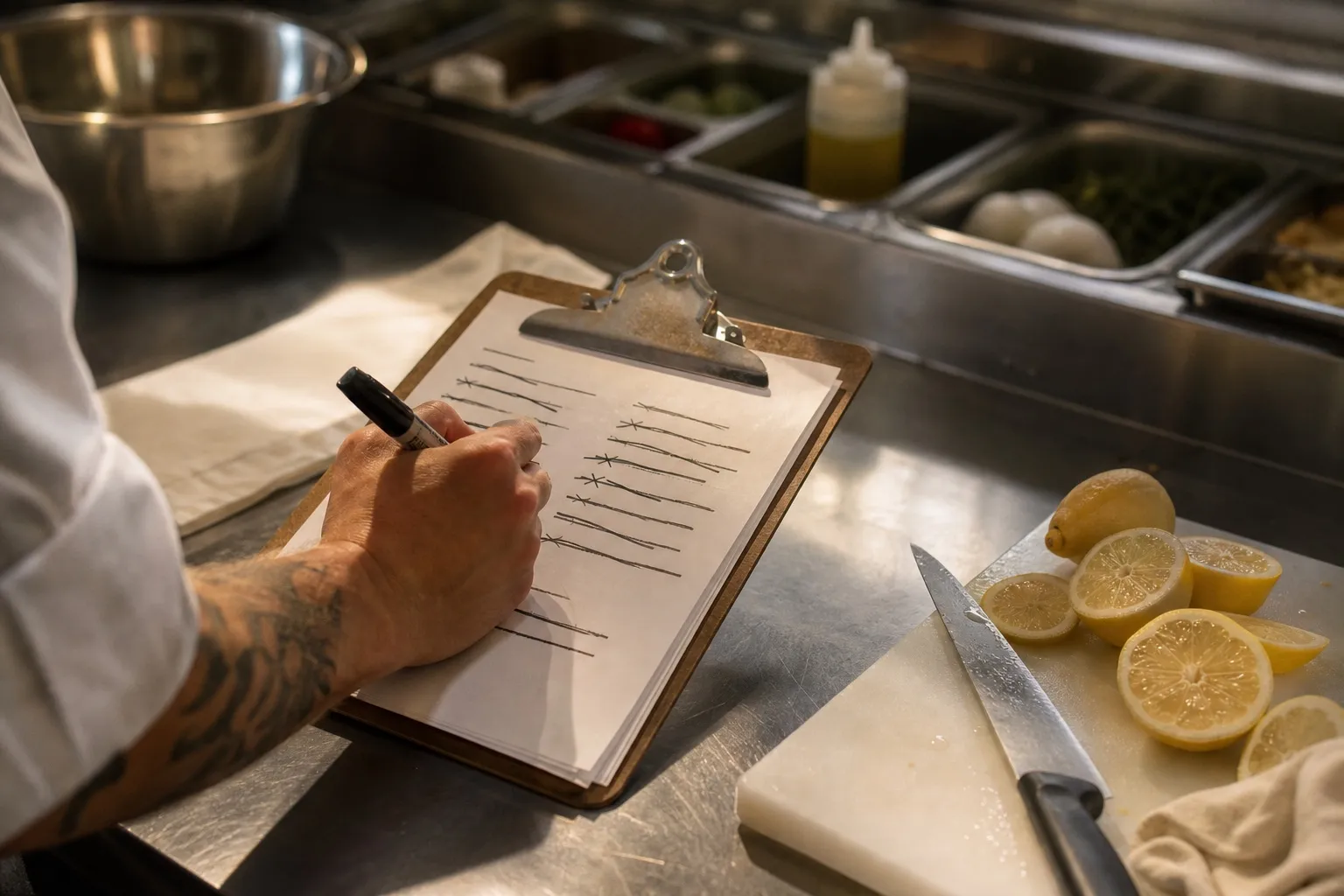
I am going to be back at the Columbus location in February, after the earnings call has come and gone and the specifics of the 2025 expansion are on the public record. I am also going to be running this same kind of stopwatch-and-clipboard observation at a McDonald’s and a White Castle in the spring, and I will be writing those up in the same format. If you operate one of these systems and you want to walk me through your numbers — on or off the record — I would very much like to hear from you. The chains that are forthcoming about their deployment math are the chains the category will compound around.
For now, Wendy’s owns this case study. Not because FreshAI is the most accurate voice agent in QSR. We do not actually know that. It owns it because Wendy’s is the only chain whose deployment math, at the moment 2025 begins, you can actually pick up and inspect. Everyone else is going to have to match that disclosure posture or be measured against it.
— Priya files The Operator. Tips: tips@tabletransfers.com.
Featured
More
Browse all 494 posts
The Voice Agent Maturity Curve
mise
·12 min read
The Four Margins of a Restaurant
mise
·14 min read
The AI Premium in Hospitality M&A: Broker Story or Real Number?
the bottom line
·9 min read
What the DoorDash/SevenRooms Deal Actually Buys
the bottom line
·11 min read