What Q1 2025 Transcripts Actually Said About AI Spend

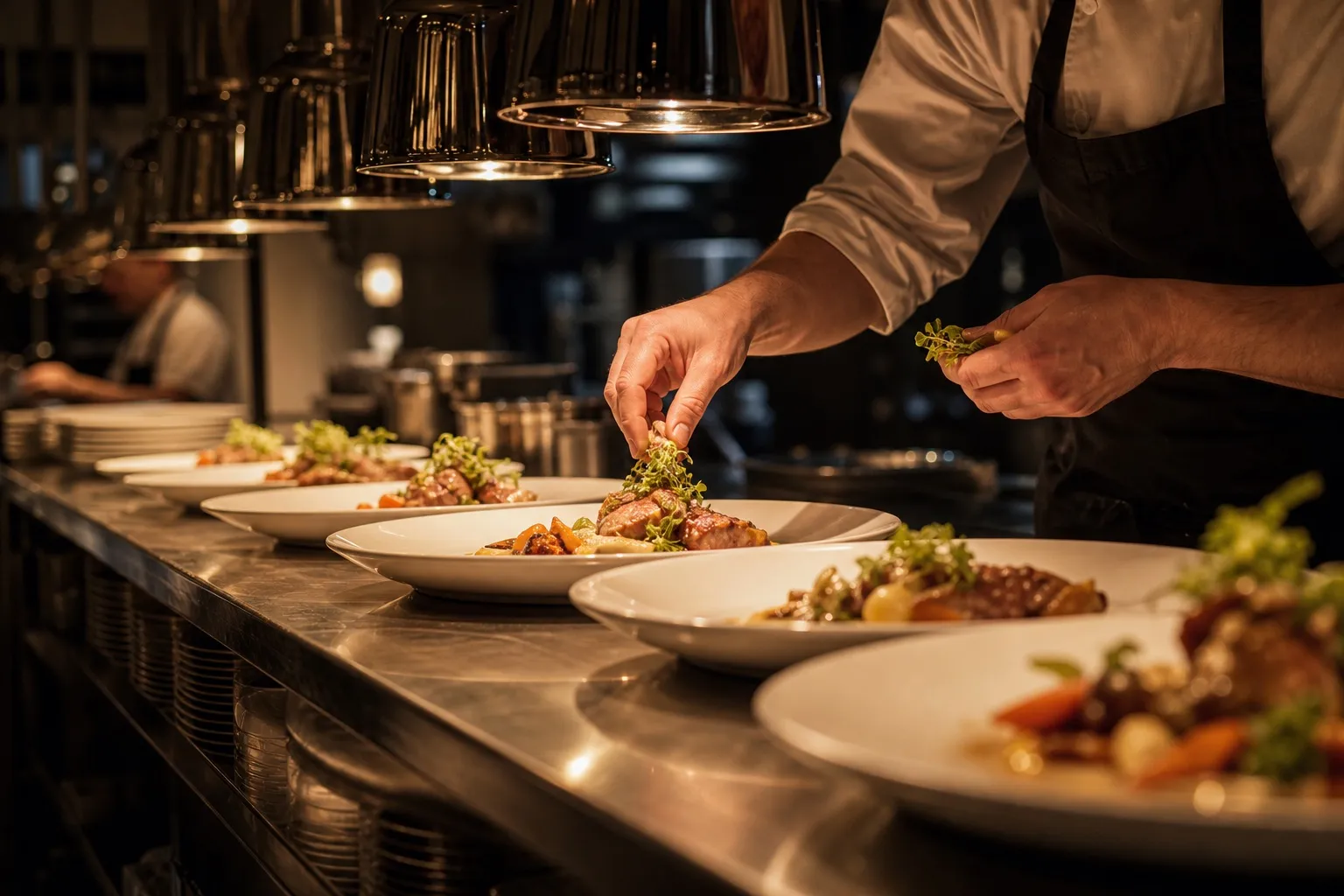
A meta-read across CAVA, Wingstop, Sweetgreen, Chipotle, Domino's, and Olo Q1 prints: operator AI spend is bounded by ROI on labor hours and order accuracy, not by vision. The platform layer should price accordingly.
I spent the last two weekends reading every May Q1 2025 transcript with a restaurant tech ticker attached to it, plus the platform companies the operators rely on. CAVA, Wingstop, Sweetgreen, Chipotle, Domino’s, Toast, Olo, Square. The exercise was meant to settle an argument I keep having with a credit analyst friend: is operator AI spend going to inflect in 2025, or is the headline noise running ahead of the unit economics? After ~120 pages of transcript and a frankly excessive amount of yellow highlighter, my conclusion is uncomfortably boring. Operator AI spend is bounded — tightly — by ROI on two line items: labor hours and order accuracy. Everything else is investor relations theater. The platform layer (Toast vs. Olo vs. Square) should be priced accordingly, and the upcoming July strategic moves around Olo only make sense through this lens.
This is a meta-read, not a stock pick. I am pulling four article-level transcripts and reading them against each other to figure out what the operators are actually willing to pay for, where the AI dollar gets cashed, and which platform sits closest to that cash.
The two-jar test: where every AI dollar gets cashed
Before I get into the operators, here is the framework I keep coming back to. Restaurant operators have, generously, two jars where an AI dollar can land and produce a return inside one fiscal year. Jar one is labor — fewer hours, less overtime, better scheduling, fewer no-shows, fewer dropped phone orders. Jar two is order accuracy and throughput — fewer remakes, fewer voids, higher digital mix, more tickets per peak hour. That’s it. Everything else — menu optimization, dynamic pricing, churn modeling, sentiment dashboards — is a multi-quarter return that gets vetoed by the franchisee or the CFO the moment same-store sales wobble.
What the Q1 transcripts confirm is that operators have internalized this. They are not buying AI as a category. They are buying labor savings and order accuracy, and they are calling it AI when it is convenient and not calling it AI when it isn’t. The platform companies that have grown into those two jars are getting paid. The ones still pitching “AI-powered guest intelligence” are getting polite nods and flat ARPU.
CAVA: discipline that reads as restraint
The CAVA Q1 2025 transcript is the cleanest example of the pattern. Brett Schulman walked through 10.8% same-store growth, a 7.5% guest traffic gain, and 15 net new openings — a quarter most operators would have killed for — and the AI commentary was conspicuously restrained. They flagged Connected Kitchen as a multi-year initiative, talked about AI-assisted forecasting and labor deployment in the same breath, and refused to put a dollar figure on the program. When pressed by analysts on the technology roadmap, the answer was effectively: we are testing, we will scale what works, and we are not going to chase a narrative.
That is exactly the posture you want from a $7B market cap operator that has earned the right to be patient. CAVA’s AI spend is bounded by what shows up in the labor line and the average ticket. Their digital mix sits in the high 30s, their throughput per hour is enviable, and the marginal return on another dollar of AI investment has to clear a hurdle that gets higher every quarter as the base case improves. The transcript implicitly priced their next dollar of AI capex at zero unless it touches drive-thru-equivalent throughput or labor scheduling. That is the discipline I want to see, and it sets the ceiling for what a platform vendor can charge them.
The math: CAVA opened 15 net new units in Q1 at a build cost north of $1.2M apiece, ran a labor cost line in the 26-27% range against revenue, and grew traffic 7.5% without obvious help from a flashy AI product launch. If the marginal labor-AI dollar can’t move that 26-27% labor ratio by at least 20 bps net of cost, it doesn’t get funded. That is a real, concrete, knowable hurdle. It also tells you that the platform vendor pitching CAVA needs to show labor outcomes in weeks, not quarters.
Wingstop: Smart Kitchen is the canonical case
If CAVA is restraint, Wingstop’s Q1 print is the canonical “AI as labor productivity” case. They doubled Smart Kitchen system installations from roughly 200 units at year-end to 400 by the time of the call — and the framing on the call was almost mechanical: cook-time reduction, ticket-time reduction, throughput uplift, labor hour redeployment. There was almost no vision language. The CFO did not call Smart Kitchen “AI”; he called it a kitchen system. The CEO talked about freeing team-member time for guest experience, which is operator-speak for “we cut labor and the customer didn’t notice.”
The number that matters is the rollout pace. Going from ~200 to 400 inside a quarter (and the first week of the next) is roughly five installations per business day across a franchised system. That is not a pilot. That is operators voting with checkbooks because the in-store P&L improved enough that the franchisee paid for it. The deployment rate is a much better signal than any earnings-call adjective.
For our purposes, Wingstop sets the upper bound on what an in-store AI/automation system can charge per location: whatever delivers a payback inside 12-18 months on a unit that does roughly $1.9M-$2.1M in AUV. That is a real, defensible number. Anyone pricing AI for QSR who isn’t anchored to that math is selling fiction. And anyone reading the Toast vs. Olo vs. Square debate needs to ask which platform sits closest to that physical, in-store productivity dollar.
Sweetgreen, Chipotle, Domino’s: the labor-vs-throughput split
Sweetgreen and Chipotle illustrate the labor side of the jar. Sweetgreen’s Infinite Kitchen narrative — and I will not relitigate the unit-economics debate here — is fundamentally a labor and throughput automation story dressed in tech-keynote clothing. The Q1 commentary treated it as a capex line that had to clear an in-store labor reduction hurdle, not as a strategic AI thesis. Chipotle’s commentary on Autocado and Augmented Makeline was similarly disciplined: they cited prep-hour reduction and consistency, and refused to commit to a fleet-wide deployment timeline until the labor math holds up across geographies and labor-rate environments.
Domino’s Q1 print sits on the throughput side. US same-store sales rose 5.6% — a number that single-handedly absorbed a lot of the macro anxiety the sector had been carrying — and the technology commentary leaned heavily on order accuracy, delivery aggregator integrations, and the Uber Eats relationship maturing. The implicit AI spend at Domino’s is in the order-routing, fraud-detection, and aggregator-orchestration layers, which is exactly the kind of unglamorous middleware that compounds margin without showing up on the call as an “AI initiative.”
Read across the three: Sweetgreen and Chipotle are buying labor-line outcomes. Domino’s is buying order-accuracy and throughput outcomes. None of them is buying AI as a category, and none of them is willing to absorb open-ended pilot spend on a vendor’s roadmap. The CFO won’t let them, and even if the CFO would, the franchisees won’t.
Olo: the platform read
This brings me to Olo’s Q1 print and the question of how the platform layer should be priced. Olo posted Q1 revenue of $80.7M, up 21% year over year, and an operating margin around 14.3% on the call’s preferred metric. That growth rate, against the operator commentary above, tells you something specific: Olo is getting paid because its order-management, dispatch, and guest-data modules sit inside the two jars — labor (fewer dropped orders, better dispatch) and order accuracy (correct items, correct address, correct time). The new modules that have been onboarding through 2024-2025, particularly around guest data and payments, will sink or swim on whether they can show the same kind of in-quarter ROI the existing modules already deliver.
Toast and Square are running a different play. Toast is bundling — payroll, scheduling, capital, retail — and using AI-flavored features to defend ARPU growth in a maturing US merchant base. Square in food is, candidly, a fast-casual and SMB story where AI features are a retention lever rather than a margin lever. Olo’s position is narrower and arguably better-suited to the operator posture I read in the Q1 transcripts: serve the enterprise multi-unit, sell into the two jars, and let the operators dictate the pace.
I will note, without claiming knowledge I don’t have, that the strategic positioning around Olo entering the back half of 2025 is going to be a live conversation. There has been chatter in PE circles for months about the enterprise restaurant tech stack being underowned by sponsors, and Olo’s Q1 numbers — 21% growth on margins now firmly in operating-profit territory — make the math easier on a sponsor model. Anything I’d say beyond that is speculation, and I won’t speculate on a deal that hasn’t been announced. But operators who run on Olo should be asking their reps what the roadmap looks like under different ownership scenarios.
What this means for the platform layer
If the operator-side conclusion is that AI spend is bounded by labor and order-accuracy ROI, the platform-side conclusion is that the vendors closest to those two jars get the durable revenue. That has three concrete implications.
First, in-store automation hardware-plus-software (Wingstop Smart Kitchen, Sweetgreen Infinite Kitchen, Chipotle Autocado/Makeline) is going to attract more capital, not less, because the unit economics are now demonstrable rather than theoretical. The Q1 transcripts gave us a baseline rollout pace. Expect that pace to compound through 2025-2026.
Second, the “AI dashboard” vendors — guest sentiment, churn modeling, personalization that isn’t tied to a specific in-store action — are going to have a brutal renewal cycle. Operators who held flat-to-down same-store growth into Q2 will cut these line items first because the CFO can’t put the savings on a slide. The vendors who survive will be the ones who attach to an order-accuracy or labor-hour metric directly. The rest will get rolled into platform suites.
Third, the platform layer (Toast, Olo, Square, plus the smaller European players) will diverge on whether they sell horizontal breadth (Toast) or vertical depth on order management (Olo). Both are viable strategies. The Q1 transcripts suggest operators are willing to pay for either one provided the ROI hits the two jars. Where they will not pay is for a third layer of analytics that sits on top of both and “synthesizes insight.” Operators are done buying synthesis. They want hours back and tickets correct.
Cross-reads and what I’m watching into Q2
For the demand-generation and front-of-house side, my read of the Q1 commentary lines up with a forthcoming May piece on the DoorDash/SevenRooms thesis I’ve been chasing — the loyalty and reservation layer is becoming a margin-recapture tool against the aggregator stack, and operators are willing to pay for it specifically because it touches a measurable line. Same logic, different jar: the AI dollar earns its keep by moving an observable P&L line, not by promising to.
On the lodging side, the operator-side restraint is even more pronounced — an upcoming May piece covers Marriott’s AI deployment posture, and the through-line is the same: deploy where the labor math or guest-conversion math is bankable, defer everywhere else. Hospitality and restaurant operators are independently arriving at the same procurement discipline, which is the strongest possible signal that the discipline is structural and not just a Q1 macro tic.
Into Q2, the three things I am watching: the Wingstop Smart Kitchen rollout pace from 400 to 600 (if it holds, the unit-economics case is closed); Olo’s strategic positioning into July (the chatter is real, the math is plausible, I won’t say more); and the franchise side of Domino’s, Wingstop, and the larger QSR systems pushing back — or not — on platform-fee increases when the operator-AI ROI gets shared between operator and franchisor.
The bottom line
The Q1 2025 transcripts said the quiet part out loud. Operator AI spend is bounded by ROI on labor and order accuracy. Vision-led pitches got polite acknowledgments and zero dollars. CAVA’s restraint, Wingstop’s deployment pace, Sweetgreen and Chipotle’s labor-line discipline, Domino’s throughput-led commentary, and Olo’s 21% growth on the back of the same two jars all tell the same story. The platform layer should be priced accordingly: depth on the two jars wins, breadth-as-narrative loses, and the sponsor-side interest building around Olo into the second half makes sense only if you believe — as I do — that the bounded operator-spend regime is a feature of this cycle, not a bug. The next four quarters will be won by the platform that proves it can move a labor hour or an accuracy point in the same quarter the invoice clears. Everything else is a slide.
— Oliver writes The Bottom Line for TableTransfers. Tips: ma@tabletransfers.com.
Featured
More
Browse all 494 posts
The Voice Agent Maturity Curve
mise
·12 min read
The Four Margins of a Restaurant
mise
·14 min read
The AI Premium in Hospitality M&A: Broker Story or Real Number?
the bottom line
·9 min read
What the DoorDash/SevenRooms Deal Actually Buys
the bottom line
·11 min read
Related posts

the bottom line
·11 min read
Darden trades like a tech company. It shouldn't.
the bottom line
·12 min read
Applebee's just became its own franchisee. The territory math is the trade.
the bottom line
·12 min read