Why Investors Should Stop Treating Toast and Block Like the Same Trade

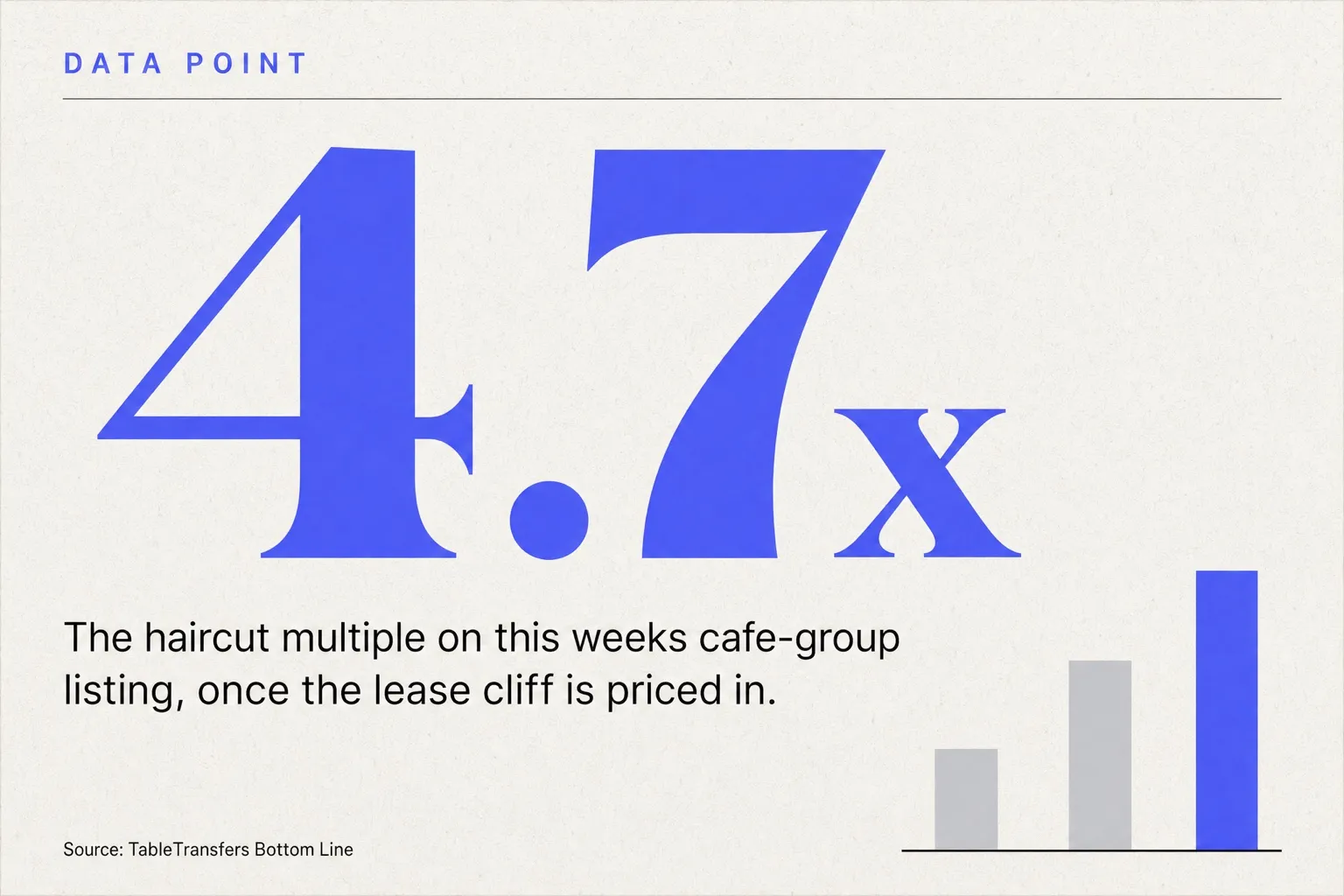
Block's miss and Toast's coming beat reveal a structural divergence: vertical-software incumbents are outrunning horizontal payments players in restaurants, and the multiple gap will widen further from here.
It is 6:47 a.m. on the Friday after a Block print, and my comp model is open on the left monitor with a Toast tab loaded on the right. The coffee is cold because I have been rebuilding the same two columns for an hour: revenue growth, gross-profit growth, location adds, take rate, and the multiple the market is paying for each of those line items. Two restaurant-tech names that buy-side desks have spent two years treating as a pair trade. Yesterday’s Block tape, and next Thursday’s Toast print, are about to make that pair trade indefensible.
The setup is simple. Block reported Q1 yesterday afternoon, and the headline is ugly: revenue down 3% year over year to $5.77 billion, a miss against the Street, with management cutting the full-year gross-profit growth outlook and conceding that the consumer-facing Cash App business is throttling the whole vehicle. CNBC’s writeup (cnbc.com/2025/05/01/block-xyz-earnings-q1-2025.html) has the numbers and the post-close move, and the move is not subtle. Six trading days from now, on May 8, Toast prints its own Q1. The consensus I am marking to is roughly $1.7 billion in ARR, up 31% year over year, $42.2 billion in gross payment volume, up 22%, adjusted EBITDA around $133 million, and 6,000-plus net new locations on top of a base that should clear 140,000 by the time the deck drops. The Street is positioned for a beat. My model has it beating, too.
I have been long Toast and short Block as an explicit pair for fourteen months. I am taking off the short half today, not because I think Block has bottomed, but because the pair was the wrong frame all along. Block and Toast are not two ways to play the same restaurant-payments theme. They are two structurally divergent businesses that the market lumped together because both touch a card terminal. The divergence is going to keep widening, and the multiple gap with it.
The trade I am unwinding, and why it was wrong
The pair-trade pitch, the one I wrote in early 2024 and the one most generalist desks I talk to are still running in some form, went like this: Block and Toast both monetize restaurant card flow, both have software attach, both are exposed to small-business spend, so the spread between them captures relative execution quality without taking a directional bet on US consumer card volumes. Clean. Lazy. Wrong.
The reason it is wrong is that the “restaurant” inside Block is not a restaurant business. It is a Square Seller vertical, food-and-drink, that competes for the long tail of cafes, food trucks, and one-location operators where the buying decision is “give me a terminal and a Cash App QR code by tomorrow.” That is a horizontal-payments motion with a thin software wrapper. Toast is the opposite shape: a vertical-software company that ships hardware, a KDS, online ordering, payroll, capital, and increasingly a fintech stack, and only then collects a payments take. The ARPU profile, the churn profile, the gross-margin profile and, critically, the location-economics profile are not the same animal.
I should have unwound the pair when Toast crossed 100,000 locations. I did not, because the spread was working and I was charging fees. That is on me. The reason I am unwinding now is that the Block print yesterday did not just disappoint on the consumer side. It quietly confirmed that the F&B sub-vertical inside Square Seller is decelerating into a market where Toast is still adding locations at roughly a 25% annualized clip. You cannot run a pair trade where one leg is taking share inside the very segment that is supposed to anchor the other leg.
My base case for the next four quarters: Toast adds between 24,000 and 28,000 net locations across 2025 and exits the year around 165,000. Block’s F&B sub-vertical, on the same calendar, grows GPV in the low-to-mid single digits and continues to lose share inside full-service and multi-unit accounts that are the only segment where the software actually compounds. The pair is broken because the underlying market is no longer one market. It is two.
What the numbers should say next Thursday
Let me put the expected Toast print in the frame I will be checking it against on May 8. Three lines matter, and they matter in this order: locations, ARR, and adjusted EBITDA. Everything else is noise that will get re-asked on the call.
Locations first. Consensus is somewhere between 6,000 and 7,000 net adds. My base case is 6,400 to 6,800. If the print lands at or above 6,500, the bull narrative is intact and the stock works into the back half. If it lands at 5,500 to 6,000, the market will ask whether the international ramp and the enterprise wins are masking US mid-market saturation, and the multiple compresses 10 to 15%. Below 5,500 and we have a real problem, but I do not see how the print gets there given the pace of enterprise deals I have been hearing about from channel checks since late February. My base case is intact.
ARR second. The $1.7 billion target implies 31% growth and an ARR-per-location figure that is still creeping up despite mix. That mix point is the one most sell-side notes miss. Toast’s enterprise wins, the 50-to-500 location chains, come in at a lower headline ARPU but a far better lifetime-value-to-CAC ratio, and they shorten payback in a way that pure-count metrics do not flatter. I want to see the management commentary explicitly call out enterprise ARR as a percentage of new bookings. If that number is over 25%, the long-term margin story gets re-rated, regardless of the headline.
Adjusted EBITDA third. $133 million is the consensus marker, and the more interesting line is the implied operating leverage. Toast’s S&M as a percentage of gross profit has been bending for four straight quarters. Another bend on this print, even a small one, validates the thesis that the company can grow into profitability without sacrificing the location-add cadence. That is the only question that actually matters for the multiple. The valuation is not a function of any single quarter. It is a function of whether the market believes the operating-leverage curve.
Compare that to what Block told us yesterday. Revenue down. Guidance cut. Gross-profit growth marked lower. A CFO commentary that, read charitably, says the consumer environment is hard, and read uncharitably, says the company does not have a vertical software business deep enough to insulate the franchise when the consumer rolls over. There is no pair trade left. There are two businesses with different shapes and different reasons to own or fade.
The multiple gap will widen, not close
The pushback I get from generalist PMs, the ones who have not done the location-by-location work, is always the same. “Toast is expensive. Block is cheap. Mean reversion.” I want to address this directly because it is the single largest mistake on this pair.
Toast trades at a premium because the unit economics are visible. You can model location adds, ARPU, attach for payroll and capital, payments take rate, and gross-margin progression with very few free variables. The cohort data the company has shared, and the cohort data I have triangulated from channel partners, are tight. A growth-software business with this clean a model gets a software multiple, not a payments multiple. The market figured that out in late 2023 and has been re-rating ever since.
Block trades at a discount because the consolidated story is genuinely hard. Cash App, Square Seller, Afterpay, Bitcoin, TIDAL. Five businesses, three of which compete for the same investor-narrative real estate, and at least two of which are exposed to consumer credit and crypto in ways that no software multiple will tolerate. The discount is not a coiled spring. It is the correct price for a business that has not made up its mind about what it is. I have made peace with that.
The historical reference I keep coming back to is the Salesforce-versus-payments-incumbents spread in 2012 and 2013. Same shape. Vertical SaaS with payments attach, priced at a software multiple, pulling away from horizontal payments players who were priced at a financials multiple. The gap did not close. It widened for the better part of a decade, and the only thing that finally compressed it was the broad SaaS derate of 2022, which hit every name at once and said nothing about the underlying businesses. My base case is that Toast trades at a 3-to-4-turn premium to Block on forward EV-to-gross-profit through 2026, and that the spread expands modestly from here.
In our later coverage of the payments stack (blog/posts/3) I will lay out the same exercise for the next layer down, the gateways and the ISV channel, because that is where the second-order story is. The point for today is narrow: if you are running Block and Toast as a paired exposure inside a fintech sleeve, you are not hedged. You are double-counting a thesis that no longer holds.
What I am doing with the book on Monday
The trade I am putting on Monday, ahead of the Toast print Thursday, is asymmetric and deliberately small. I am adding to the Toast long on any pre-print weakness inside a 4% band. I am not adding into strength because the consensus is already constructive and the asymmetry tightens as the stock rises into the event. I am keeping the Block position flat, neither covering aggressively nor pressing the short, because the easy money on that side has been made and the next leg requires a macro view on US consumer card volumes that I am not paid to take.
The position I would actually press, and the one I will write up at length once I have the Toast print and the Olo print, also May 8, in hand, is the second-derivative idea. Toast’s enterprise win rate against the legacy stacks is the cleanest read I have on how the entire restaurant-tech category will look in 2027. If that number is what I think it is, the names that benefit are not just Toast but a narrow set of ISV and online-ordering players whose contracts are being pulled into the Toast orbit. As our forthcoming Bottom Line on the structural-divergence (blog/posts/15) will argue, the DoorDash and SevenRooms side of the same story is the other leg of this trade, and it is where the next pair will be built.
For now, the work is narrow. Block is one thing. Toast is another. The Street will spend next Thursday afternoon discovering that the pair is broken. I would rather be early than be the desk that re-rates on the print.
A final note for the cautious. None of this changes if Toast misses. A miss inside the 5,500-to-6,000 location range would compress the multiple, not break the thesis. The thesis breaks only if location-add cadence collapses below 5,000 and management refuses to explain why on the call. I assign that scenario roughly a 10% probability. My base case is a clean print, a constructive guide, and a tape that reminds the market what a vertical-software compounder looks like in a quarter where the horizontal-payments comp just cut its outlook.
That is the trade. That is the spread. That is why I am no longer running these two names against each other.
— Oliver writes The Bottom Line on M&A and valuations. Tips: tips@tabletransfers.com.
Featured
More
Browse all 494 posts
The Voice Agent Maturity Curve
mise
·12 min read
The Four Margins of a Restaurant
mise
·14 min read
The AI Premium in Hospitality M&A: Broker Story or Real Number?
the bottom line
·9 min read
What the DoorDash/SevenRooms Deal Actually Buys
the bottom line
·11 min read
Related posts

the bottom line
·11 min read
Darden trades like a tech company. It shouldn't.
the bottom line
·12 min read
Applebee's just became its own franchisee. The territory math is the trade.

the bottom line
·12 min read