Yum/Nvidia and the Restaurant-Tech Multiple Reset

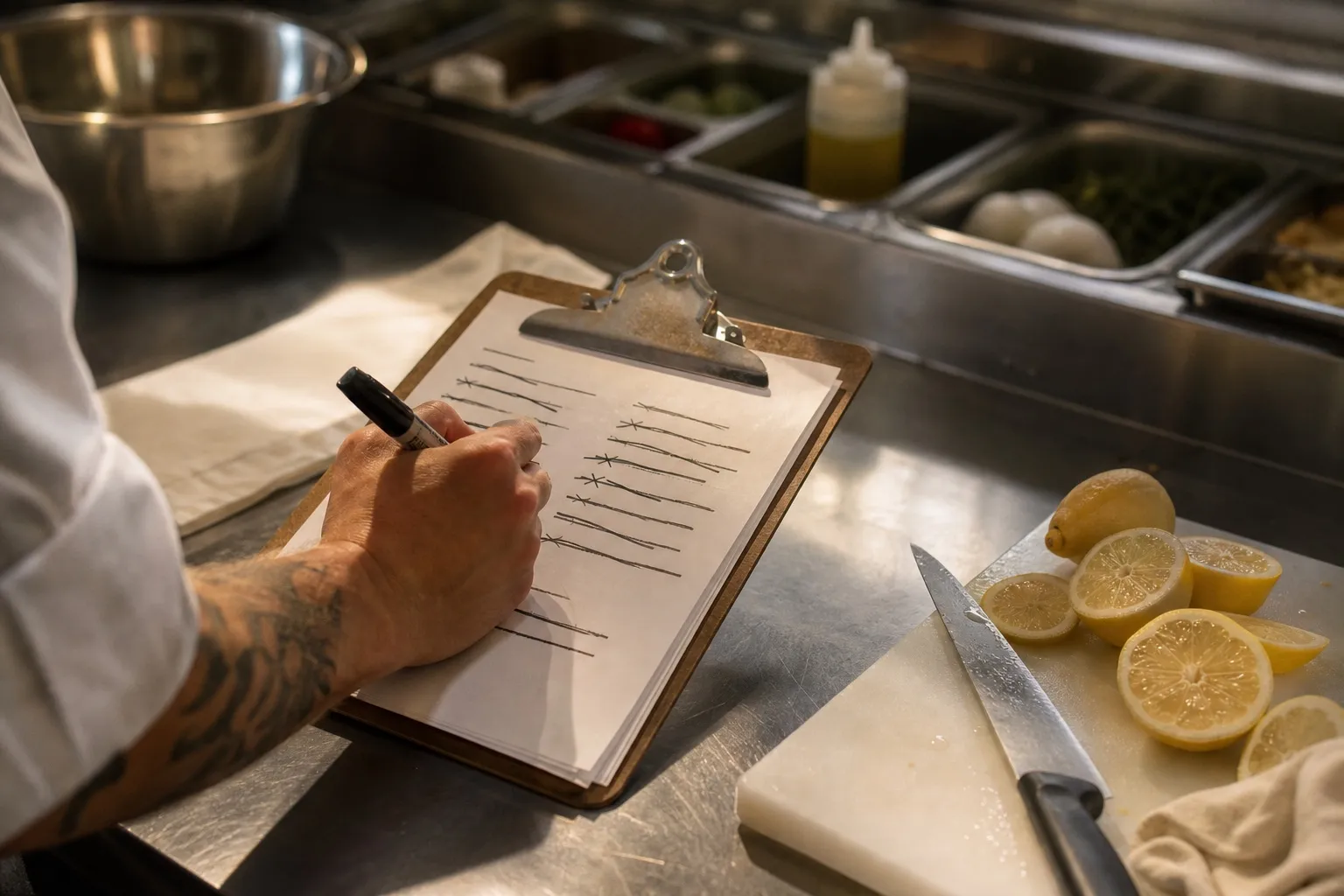
The GTC partnership re-rates the entire restaurant-tech complex — TOST, OLO, SOUN, PAR, LSPD — by establishing a new comparable for AI-led operating leverage.
It’s Friday afternoon and the second monitor on my desk has a re-rate comp model I’ve been pushing around since Tuesday. The first monitor has the Yum 8-K, the Fortune readout, and the Toast and Olo charts pulled up side by side. The week started on a screen at GTC in San Jose and is ending on my screen in a coffee shop on Tenth Avenue, and the throughline is the same: every restaurant-tech ticker I cover now has to defend its multiple against a comparable that didn’t exist on Monday.
Tuesday’s Yum/Nvidia announcement at GTC, formalized in Yum’s 8-K and amplified through the Fortune readout on the drive-thru AI partnership, did one thing the trade press has not fully metabolized. It gave Nvidia a referenceable enterprise restaurant footprint of 61,000+ locations. Not a pilot. Not a 30-store proof of concept. An operational rollout running on Byte by Yum and announced from the keynote stage at the most-watched AI conference of the year.
That is a comparable. And once a comparable exists, every other restaurant-tech name has to argue why it should not be valued at a discount to it.
That is the trade. Let me walk it.
The comp didn’t exist on Monday. It exists now.
Before GTC, the way the sell side framed restaurant tech was as a category of bottom-up SaaS stories. Toast is a vertical-SaaS roll-up at 130,000+ locations. Olo is a digital-ordering layer at roughly 88,000 locations on its enterprise footprint. SoundHound is a voice AI specialist that, on its Q4 2024 disclosure, has been building toward an enterprise restaurant book that the company has guided to a small-double-digit number of chains by mid-2025 — and I want to be careful here, because the cleanest forward number SoundHound is expected to disclose for restaurant deployments lands ten days out from this column, and I am not going to front-run a print. PAR Technology is the legacy POS modernizer. Lightspeed is the international hospitality story. Each of these has been valued, broadly, on revenue multiples informed by their own historical bands and by software-comp tables. The AI piece sat in each story as a premium — something that lifted multiples at the margin if you believed management’s articulation of the roadmap.
Yum/Nvidia changed the shape of that conversation. The announcement establishes that an enterprise restaurant operator at 61,000+ locations is now an AI platform reference customer for the company that owns the AI accelerator stack. The deploy cycle Nvidia and Yum are framing for voice agents — call it three months from kickoff to in-store operation, with a 500-restaurant Q2 rollout anchoring the timeline — is fast enough to be operationally credible and slow enough to be operationally believable. It is not vapor. It is a schedule.
This part is interpretation, marked as such: the moment a 61,000-unit operator is positioned as the demonstrable AI-platform comp, every restaurant-tech name with an AI roadmap now has to defend its multiple against a benchmark whose denominator includes hard unit counts, hard deploy times, and a partner whose market cap is larger than the entire restaurant-tech complex combined. The premium is no longer abstract. There is a number on the screen.
That changes what you are buying when you buy TOST, OLO, SOUN, PAR, or LSPD. You are no longer buying a software story with an AI premium tacked on. You are buying a software story that has to explain why it deserves to trade at a band that is not visibly discounted to the new top comp.
My base case on the re-rate, name by name
Let me put the comp model on the page. Numbers below are interpretation; the directional ranking is what I will defend.
Toast. 130,000+ locations on Toast’s most recent disclosure, vertical SaaS with payments attach, and an AI roadmap that the ainvest writeup on Toast’s tech moat frames cleanly as a scale-and-data-spine story. My base case: Toast is the least exposed to the re-rate. The 130k-location footprint is more than 2x Yum’s enterprise unit count, the data spine is operational, and Toast’s AI surface — order-entry upsell, conversational assistant, forecasting — is shipping at scale. The defensible read is that Toast is the SMB and mid-market comp to what Yum/Nvidia just announced at the enterprise tier. If anything, the GTC headline gives Toast cover to argue for multiple expansion, on the read that the market now has a reference point for what AI-led operating leverage in a restaurant network looks like and Toast owns the larger denominator.
Olo. ~88,000 locations on the enterprise side, the digital-ordering and guest-data layer for a meaningful slice of the U.S. enterprise restaurant book, and a multi-year story about being the connective tissue between POS and the consumer. My base case: Olo is the most interesting trade in the basket. The GTC partnership is structured around voice and drive-thru — channels Olo does not directly own — but it implicitly validates that enterprise operators are committing to AI-native ordering surfaces. Olo’s job, between now and the next print, is to demonstrate that its 88k-location surface is a complement to the Yum/Nvidia stack, not a substitute. If Olo can frame itself as the cross-chain platform that any operator running Nvidia inference can plug into, the re-rate goes its way. If the market frames Olo as a layer that Yum’s vertical stack could displace, the re-rate goes against it. I do not yet know which side of that the sell side will land on. I am watching the next earnings call for the framing.
SoundHound. The pure-play voice AI ticker, and the name where the re-rate cuts hardest. Care here: SoundHound’s most recent disclosed restaurant footprint, on the Q4 2024 print, is in the high-single-digit enterprise chains, with management language suggesting that number will be larger by the next disclosure. I am not going to put a forward-looking unit number on the page that the company has not put on the page itself. What I will say is that the GTC moment frames the defensible SOUN narrative: SoundHound’s enterprise chain count needs to be growing fast enough that the gap between its disclosed footprint and the 61,000-unit reference customer reads as a category-being-validated story, not a category-already-captured story. The risk for SoundHound is that the market reads Yum/Nvidia as proof that the voice-AI layer at scale belongs to the operator-plus-Nvidia stack, not to a third-party voice specialist. The opportunity is that the same headline drags every other QSR enterprise into the buying conversation, and SoundHound is on the short list of vendors who can ship into that conversation. My base case: SOUN is the highest-beta name in the basket on the re-rate. It can grind 20% in either direction on the framing alone.
PAR Technology. The legacy POS modernizer, with a multi-year story about being the enterprise-grade alternative to the cloud-native challengers. My base case: PAR is interestingly positioned. The GTC partnership runs on top of an enterprise POS estate that, in Yum’s case, includes a meaningful PAR footprint at the Pizza Hut and KFC layer. PAR can credibly argue that it is the infrastructure the new top comp is built on. Whether the market gives PAR credit for that depends on how the partnership is structured commercially and on whether the next PAR print contains language that explicitly ties the AI workload to the POS estate. Watch: PAR’s next earnings commentary on AI-enabled enterprise wins is the tell.
Lightspeed. Hospitality and retail, international footprint, and a multi-year transition out of an aggressive SMB story into a more focused enterprise hospitality story. My base case: Lightspeed is the least affected by the Yum/Nvidia re-rate, because its book is not anchored in the U.S. enterprise QSR layer where the new comp sits. The risk for LSPD is the opposite — being valued in a band that is increasingly anchored to U.S. AI-native QSR comps when the LSPD business is structurally different. That is a multiple-narrative problem, not an AI-execution problem. I expect Lightspeed to spend the next two quarters trying to reframe itself as the international hospitality AI story, with the same data spine and the same vendor partnerships ported into a different category.
That is the table. Interpretation throughout — I am explicit about it. The ranking I will defend: TOST and PAR are positioned to benefit, OLO is the volatile name to watch, SOUN is the highest-beta name in either direction, LSPD is the least affected on the day and the most exposed to a follow-on narrative reset.
What the three-month deploy cycle actually does to the comp set
The piece of the Yum/Nvidia announcement the analyst notes I have read this week have mostly underplayed is the deploy cadence. Three months from kickoff to live voice agents at a store, with a 500-restaurant Q2 rollout anchoring the next wave.
That is a fast number for enterprise restaurant tech. The historical bands for AI deployment at the drive-thru tier — the ones I was modeling against six months ago — were 9 to 18 months from kickoff to in-store, with a substantial pilot-to-rollout gap and a recurring pattern of pilot reversals. Yum/Nvidia compresses that to three months. If that number holds — and the Q2 rollout will be the first hard test of whether it holds — it changes the deploy-curve assumption embedded in every other restaurant-tech AI roadmap.
My base case: the sell side updates its restaurant-tech deploy-curve assumptions inside two quarters. The names that benefit from a faster assumed deploy curve are the ones with the bench strength to ship at that cadence — Toast and PAR top of the list, Olo on the digital-ordering side. The names that get penalized are the ones whose deploy cycles run measurably slower than the new benchmark. That is a structural multiple effect, not a quarterly effect.
This is also the read I want to mark against the Q1 enterprise framing and the forthcoming Q2 M&A roundup: the deploy-curve compression is a category-level input, and it shows up in every comp table I run for the rest of the cycle.
What an M&A buyer pays for, on the new comp set
Here is the place this gets interesting from an M&A lens, which is the part of my mandate that runs longer than the quarterly trade.
A strategic buyer evaluating the restaurant-tech complex post-GTC pays for one of two things. They pay for the data spine — the enterprise-scale footprint that the new top comp validates as a category — or they pay for the AI surface — the specific capability layer that an enterprise operator would license rather than build with Nvidia directly.
Toast is a data-spine asset. Olo is a data-spine asset. PAR is a data-spine asset with a brownfield modernization story. SoundHound is an AI-surface asset. Lightspeed is a data-spine asset on a different geography. The Yum/Nvidia comp gives an acquirer the cleanest framework I have seen for sizing what each layer is worth at scale.
My base case for an M&A scenario over the next 12 months: the most interesting transaction in the basket is a strategic acquirer — could be a payments incumbent, could be an enterprise-software roll-up, could be an operator — buying an AI-surface asset (SOUN being the most plausible target on size) at a premium that prices in the deploy-curve compression. The premium is not extraordinary on the new comp set. It is justifiable. A second scenario — a data-spine name absorbing a complementary data-spine name — is less likely in the near term because the regulatory and integration overhead does not pencil at current multiples.
That second scenario is the one the broader M&A coverage tape will need to track, and the one I will write up when the bidder list surfaces.
The thing that has to be true for the re-rate to hold
I want to be honest about what could break this read.
Yum/Nvidia is a partnership announcement at a developer conference. The 500-restaurant Q2 rollout is the operational test. If the Q2 rollout slips, or if the in-store voice agents underperform the order-accuracy benchmarks the market is expecting, the comp becomes weaker than the day-one framing. The re-rate I am describing is contingent on the operational delivery matching the partnership marketing.
I am not in the data room. Neither is the market. The Q2 print and the in-store metrics — whether they come from Yum’s earnings call, from franchisee feedback, or from operator-side trade press coverage — will be the test. If the rollout delivers, the re-rate I am describing accelerates and the multiple compression on the laggards in the basket becomes a structural feature of how restaurant tech trades for the rest of 2025. If the rollout stumbles, the comp weakens, the re-rate stalls, and the basket reverts to the bottom-up story it was on Monday.
My read on the probability of the rollout delivering — and this is interpretation — is that the operational risk is real but bounded. Yum has been running the Byte platform for long enough that the integration surface is known. Nvidia would not have anchored the keynote on a partnership it did not believe would print. The asymmetry sits on the upside.
The trade for the next quarter, then, is to position around the names that benefit from the re-rate holding, while keeping enough optionality to fade the highest-beta names if the Q2 rollout disappoints. Toast and PAR are the cleanest exposures on the upside. SoundHound is the trade for the operator who can underwrite the beta. Olo is the framing trade — it goes the way the next earnings call positions it. Lightspeed is the patience trade.
That is the table. The new top comp is real. The deploy curve compresses. The multiples reset.
The Q2 print tells you whether I am early or late.
— Oliver writes The Bottom Line on M&A and valuations. Tips: tips@tabletransfers.com.
Featured
More
Browse all 494 posts
The Voice Agent Maturity Curve
mise
·12 min read
The Four Margins of a Restaurant
mise
·14 min read
The AI Premium in Hospitality M&A: Broker Story or Real Number?
the bottom line
·9 min read
What the DoorDash/SevenRooms Deal Actually Buys
the bottom line
·11 min read
Related posts

the bottom line
·11 min read
Darden trades like a tech company. It shouldn't.
the bottom line
·12 min read
Applebee's just became its own franchisee. The territory math is the trade.
the bottom line
·12 min read