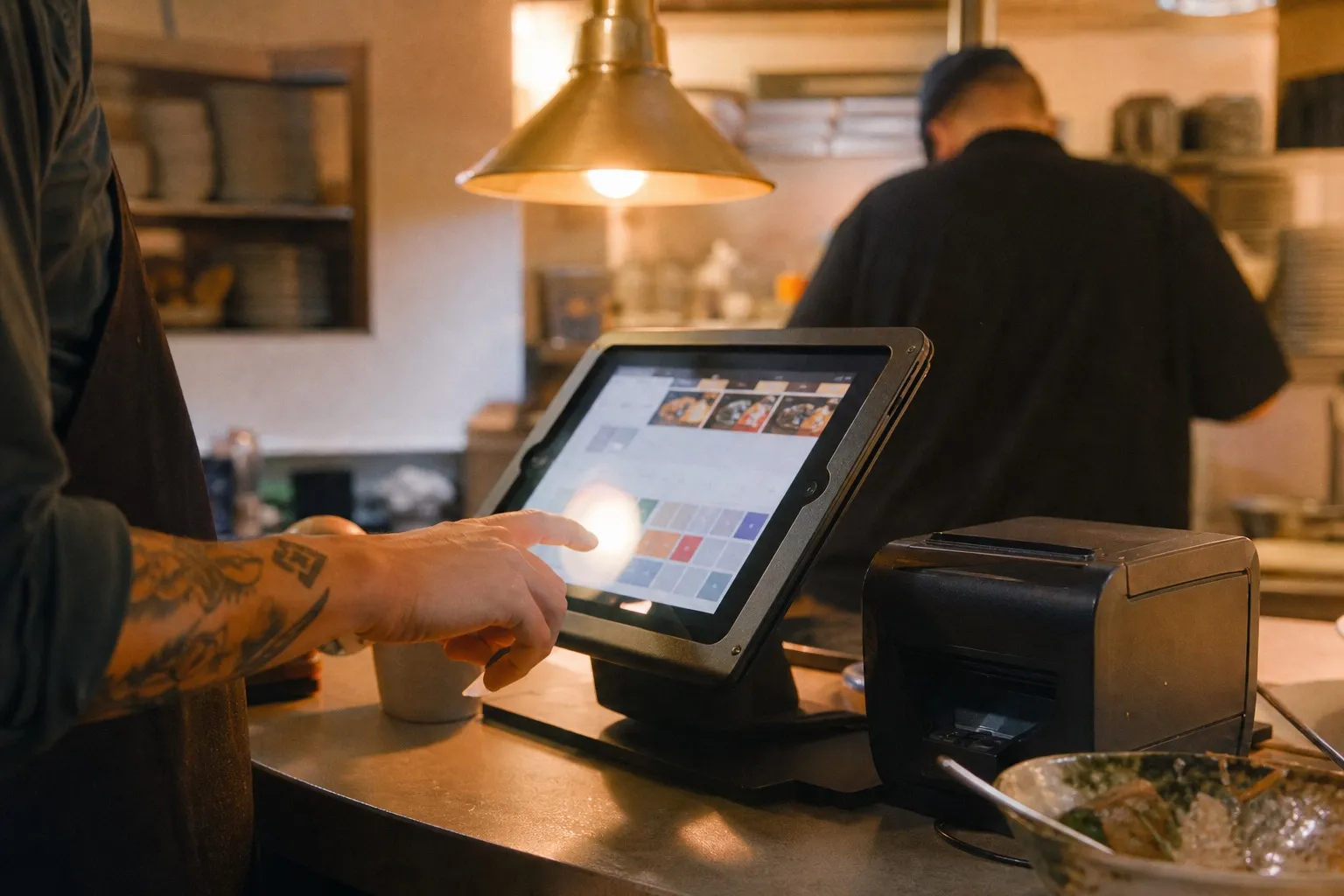
McDonald's Bets on Edge AI for 43,000 Restaurants

Today's WSJ scoop on McDonald's edge-AI rollout is the largest single AI infrastructure deployment in QSR history. The move makes Google Cloud's restaurant practice the de-facto rival to Nvidia's Yum partnership two weeks before GTC.
I was in a Chicago franchisee’s back office on Madison Street when the WSJ alert hit my phone — espresso cooling, last week’s drive-thru times open on the desk. McDonald’s is wiring edge computing into all 43,000 of its restaurants, with Google Cloud as the substrate, IoT telemetry from the fryers and McFlurry machines, computer-vision order verification, and — the phrase that’s going to be quoted back at every QSR CTO for the next year — “virtual AI managers” in the back of house.
Brian Rice, McDonald’s CIO, gave the on-record framing. The Salon syndication is the cleanest non-paywalled read; TheSpoon’s writeup is the most useful for understanding what’s actually shipping versus what’s marketing.
The number is 43,000. Not because it’s a record — though it is — but because of what it implies about latency, infrastructure, and where the AI compute lives.
What WSJ actually scooped
Strip the press-friendly language out and there are four concrete things in this announcement.
One, edge computing across the system. Every restaurant gets local compute — a box on premise running models on store-generated data, not a thin client phoning a cloud region. Two, IoT instrumentation on the kitchen line: fryers, McFlurry machines, presumably grills and shake towers, all reporting telemetry. Three, computer-vision order verification at assembly — the camera-watches-the-tray pattern, now at a 43,000-store reference deployment. Four, “virtual AI managers” — an ambient-intelligence layer surfacing operational nudges to crew and shift managers in real time.
The framing the company is leaning into, per Rice via WSJ, is that edge is faster and cheaper than a cloud round-trip. That line is doing more work than it looks like it’s doing.
My read: this is McDonald’s saying, in the politest possible corporate register, that they don’t trust cloud round-trip latency for drive-thru AI. Which is the right answer.
Why edge beats cloud at the drive-thru
The drive-thru is the unforgiving environment for AI in our industry, and it’s the one place where the abstract debate about edge versus cloud has a concrete winner.
Consider the loop. A car pulls up. The customer says, in a Boston accent at 7:14 a.m., something that may or may not be “large iced coffee, three sugars, light cream.” The order is parsed, confirmed through the speaker, sent to the kitchen, assembled, verified by camera, handed off — ninety seconds at a well-run store. The AI has to do speech recognition, intent parsing, menu disambiguation, upsell logic, and order verification, every one of them real-time.
A cloud round-trip from rural Missouri to a regional region is fifty to a hundred and fifty milliseconds before anything inferences. Stack a few of those and you’ve burned half a second on network. McDonald’s runs hundreds of millions of drive-thru transactions a month. Half a second across that volume is not a rounding error.
Edge collapses the round-trip. The model runs in the building. Fryer telemetry never leaves the building unless aggregated. The vision check happens on a GPU twenty feet from the camera. You get latency that’s predictable — which is, in a kitchen, frankly more important than merely lower.
There’s also a cost story underneath. Cloud inference at 43,000-restaurant scale, running continuously, is a number that would make any CFO blanch. Edge moves that into capex — local hardware, depreciated over five-plus years — instead of opex you pay a hyperscaler forever. Rice’s “cheaper” line is doing that work.
My read: McDonald’s just bought 43,000 small data centers. That’s the actual story.
What this does to Nvidia’s Yum announcement
The timing is not accidental.
Five weeks ago Yum launched Byte by Yum across KFC, Taco Bell, and Pizza Hut. The AI partner was not named, and I wrote at the time that I expected an Nvidia reveal around GTC. GTC starts March 18 — thirteen days from today. Yum’s existing Dragontail computer-vision relationship runs on Nvidia silicon.
McDonald’s just preempted it. By two weeks.
The McDonald’s-Google Cloud partnership has existed since 2023 in a limited form. Today’s scoop expands it into the AI-infrastructure layer of every restaurant. Google Cloud’s restaurant practice — a distant third to AWS and Azure in QSR enterprise deals, hunting for a marquee win for two years — just got it. And positioned as edge-first, exactly the philosophy Google has pushed with Distributed Cloud Edge.
The QSR AI map looked muddled six weeks ago. It now reads as a clean split: Google Cloud plus McDonald’s on edge; Nvidia plus Yum on, presumably, a more centralized GPU-heavy stack with vision pushed to stores. We’ll know the second side at GTC. The first we know today.
Wendy’s holds its Investor Day tomorrow, March 6, and I’d be unsurprised if FreshAI gets re-framed in light of today. The big four have to pick a lane, and the lanes just got named.
What McDonald’s franchisees will pay for
Last thing worth flagging is the operator economics, because nobody else will write about this for another week.
Edge boxes are capex. At 43,000 restaurants and even a conservative per-site hardware bill, this program runs into the high nine figures. McDonald’s corporate is not eating all of it. Some comes through the technology fee structure franchisees already pay; some through new contributions tied to the rollout. The National Owners Association was unusually quiet today, which I read as waiting to see the cost-sharing terms before deciding whether to push back.
Watch that. The model only works if operators see the through-line from edge-AI capex to measurable per-store P&L improvement. Order accuracy is the obvious lever. Labor productivity from “virtual managers” is the second. Equipment uptime — courtesy of IoT-instrumented fryers — is the third, and as our subsequent operator case study on Chipotle’s tech stack will get into, equipment-standards obsession is increasingly correlated with margin.
A distribution wrinkle for a later piece on the DoorDash Commerce Platform: if McDonald’s runs on-premise vision and order-state telemetry at every store, marketplace partners have a new API surface to negotiate against. A 2026 conversation, but it starts today.
If McDonald’s can show a measurable point of order accuracy and a measurable reduction in fryer downtime across the first thousand stores, the franchisee conversation is over. If they can’t, this becomes the largest expensive infrastructure deployment in QSR history with no operator endorsement, and the Yum side of the split starts looking smarter.
My read: edge wins, and McDonald’s made the bet two weeks before Nvidia made the opposite one. Twelve months tells us who guessed right.
— Luca covers restaurant operators. Tips: tips@tabletransfers.com.
Featured
More
Browse all 494 posts
The Voice Agent Maturity Curve
mise
·12 min read
The Four Margins of a Restaurant
mise
·14 min read
The AI Premium in Hospitality M&A: Broker Story or Real Number?
the bottom line
·9 min read
What the DoorDash/SevenRooms Deal Actually Buys
the bottom line
·11 min read