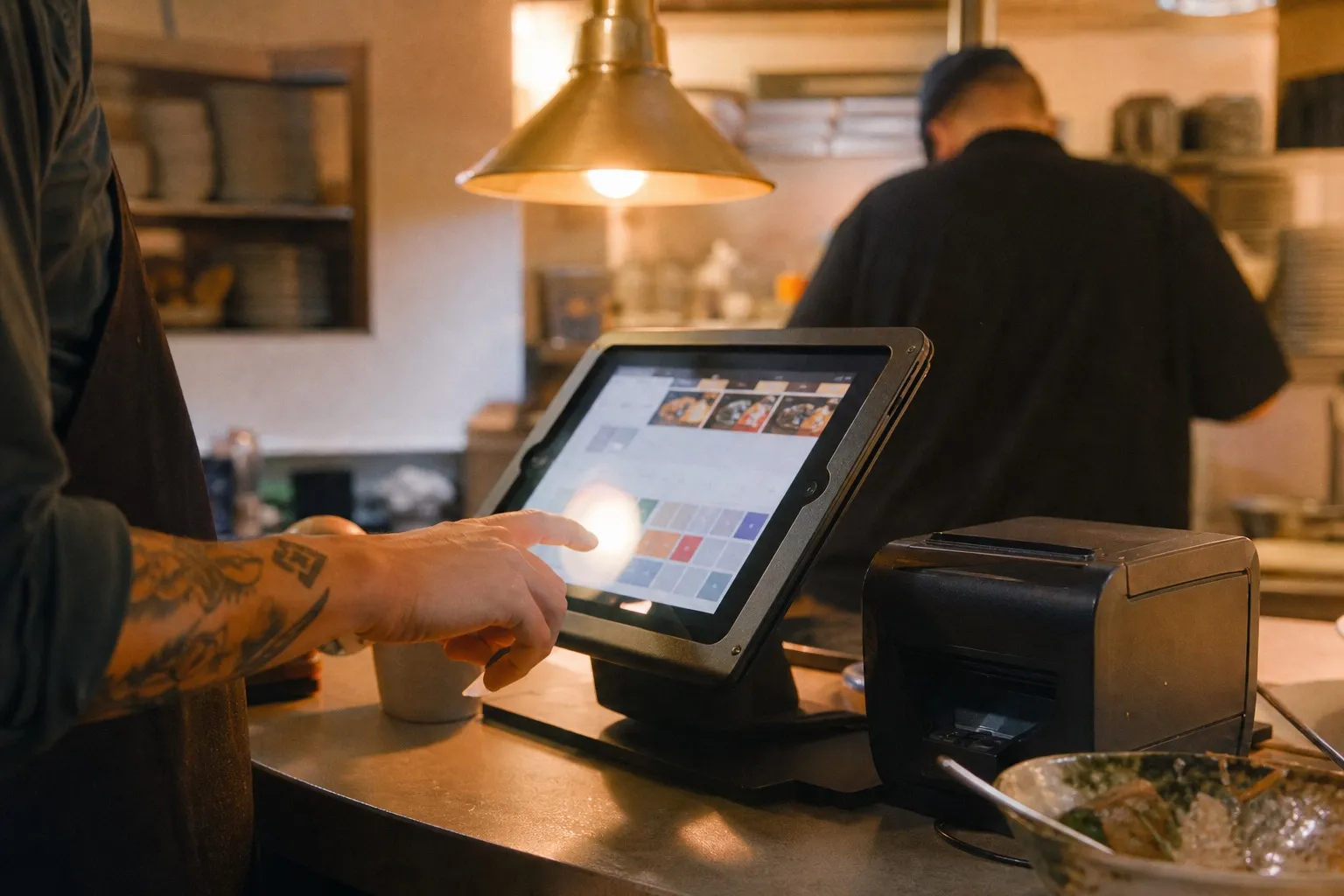
Toast Drive-Thru ships: Delphi hardware + Incept AI + 55" confirmation screens, gated to 15+ unit chains

Toast Drive-Thru launched Tuesday morning with Delphi hardware, an Incept-powered AI voice-ordering layer, and 55-inch order-confirmation screens — gated to brands with 15 or more locations. The enterprise-only filter is the strategy, not an oversight, and the hardware story reads sharper than anything the rest of the board has on the runway.
I was at my kitchen desk at six-forty on Tuesday morning, the second coffee of the day going cold, when the Toast Drive-Thru release crossed the wire. The press copy was longer than the Toast template usually runs, and the reason was hardware: Delphi-built drive-thru units, 55-inch high-brightness order-confirmation screens, a POS-native drive-thru mode, and an AI voice-ordering layer with Incept and other partners, all bundled into one product, gated at announcement to brands with 15 or more locations. I read the gating line twice. That is the story.
The contrarian thesis I want to put down before this gets pattern-matched as “Toast finally has drive-thru”: the 15-unit floor is not a soft launch artifact, it is the deliberate strategy. Toast spent the last eighteen months winning the 50–200-unit segment with POS and Kiosks; Drive-Thru is the product that walks the same go-to-market into the lane where Olo’s voice-AI partnerships and NCR Voyix’s legacy installed base actually live. Filing this one as enterprise-only at launch is Toast telling the analyst community where the SKU is pointed before anyone has the chance to misread it as an SMB play.
The hardware story is the thing nobody else can match yet
The piece of this release that I want operators to slow down on is the Delphi integration. Drive-thru hardware is not a category most POS companies pretend to ship — the speaker posts, the weather-rated lane controllers, the high-brightness screens that have to survive a Texas July, all of that is hardware that has historically lived with a different vendor than the POS. PAR has gone partway there through acquisitions; NCR Voyix inherits a long tail of installed lane hardware that is mostly aging out. Toast is shipping a Delphi-built unit into the lane on day one, which is the part of the bundle that the rest of the board is going to find hardest to replicate inside a single procurement cycle.
The 55-inch order confirmation screens are the other tell. The OCS lane is where Presto, Vistry, and a handful of other point solutions have been pitching upgrades to 15-year-old screens that operators are sick of looking at. Toast putting a 55-inch high-brightness unit into the standard configuration — not as an upsell — is the bundle math working the way the Kiosk math worked at Ike’s. The chain that signs the POS conversion gets the screen and the lane controller in the same paperwork. That is procurement leverage, and it is the lever Toast has been pulling consistently this year.
And then there is the voice layer. The Incept partnership is the headline most of Tuesday morning’s press took, and Incept is a credible name — they have done real volume in the QSR drive-thru — but I would caution against reading the Incept callout as a single-vendor commitment. Toast’s framing was “Incept and other partners,” which is the company keeping the voice layer plural by design. McDonald’s has been the cautionary tale in this category for two years; Toast knows it, and the forthcoming desk read on the McDonald’s AI drive-thru retrospective is the context I want to bring into this one when the rest of the chain pipeline starts to publish.
Read against Square, the comparison is uneven
Square is the other shoe to drop. The company has been telegraphing a forthcoming drive-thru product for the May 11 stage, and what we know about the Square approach is consistent with the rest of Block’s restaurant strategy: software-forward, hardware-light, aimed at the operator who is already on Square for Restaurants and wants to extend a single lane. The two products are not going to compete for the same customer at launch. Square’s drive-thru, as it has been previewed, is aimed at independents and small groups — the operator with two or three lanes who has been bolting on a third-party speaker post. Toast’s drive-thru is aimed at the 15-unit chain that is currently running a fifteen-year-old Panasonic system and is overdue for a replacement.
That is the segmentation that Tuesday’s release made legible. Toast did not gate the SKU at 15 units because they could not handle smaller volumes — they gated it because the 15-unit chain is the customer the Delphi-and-screens bundle is actually built for. Square’s forthcoming product is going to be the smaller-chain counterweight, and when both are in market the category will read as bifurcated rather than head-to-head. Mark that. The competing-product narrative is going to want to write Square vs. Toast as a single race, and the segmentation is going to make that frame wrong.
What the May call will and will not tell us
The Q1 print is on May 7, and the company will detail the enterprise TAM math on the call. What I am listening for is not the headline ARR — that number will be the number — but the composition disclosure. Drive-Thru is a product that, if it works the way the deck implies, shows up in net-new-ARR-per-location rather than in pure location count, and that is a metric Toast has not historically broken out in detail. If the May call gives us a per-location ARR uplift number for the chains that take the Drive-Thru SKU on top of the POS-and-Kiosk base, that is the disclosure the bull case has been waiting for.
The cross-link I want operators tabbed for context: the Toast IQ rebrand framing from last year is what the AI voice layer plugs into; the forthcoming desk review of the full Toast suite will read Drive-Thru against the rest of the bundle once the May print is out; and last week’s Ike’s deployment was the chain-segment data point that made Tuesday’s launch read like a continuation rather than a pivot. The pattern across the four — IQ in the lobby, Kiosks at Ike’s, Drive-Thru at the lane, the suite review in May — is the same one I have been marking since February. Toast is filling the bundle, one SKU at a time, and shipping each one into the segment where the bundle math actually closes the deal.
Toast got Drive-Thru out the door, with the hardware. Olo, Square, and NCR Voyix all wanted that headline. That is the marker for the rest of April.
— Maya covers restaurant tech for TableTransfers. Tips: tips@tabletransfers.com.
Featured
More
Browse all 494 posts
The Voice Agent Maturity Curve
mise
·12 min read
The Four Margins of a Restaurant
mise
·14 min read
The AI Premium in Hospitality M&A: Broker Story or Real Number?
the bottom line
·9 min read
What the DoorDash/SevenRooms Deal Actually Buys
the bottom line
·11 min read